Introduction
Tangled cables. A charger that falls out the moment you pick up your phone. A desk cluttered with three different charging bricks for three different devices. If any of this sounds familiar, you already understand why magnetic charging technology has become one of the most sought-after categories in the smartphone accessories market.
The way we charge our devices has changed dramatically over the past decade — and it’s still changing fast. From the early days of proprietary connectors to the rise of USB-C and Qi wireless charging, the industry has been steadily moving toward a single, universal vision: a seamless, cable-free, magnetically aligned charging experience. That vision is now a reality, and magfusehub com is one of the destinations making it accessible to everyday users.
In this guide, we’ll break down everything you need to know about magnetic charging accessories, how MagSafe technology works, what to look for when shopping for wireless charging solutions, and how to build the cleanest, most efficient charging setup possible — whether at your desk, at home, or while traveling.
What Is magfusehub com?
magfusehub com is an online platform specializing in magnetic charging accessories, MagSafe-compatible products, and wireless power solutions for modern smartphones and devices. The platform brings together a curated selection of magnetic chargers, wireless charging stations, portable magnetic power banks, magnetic charging cables, and a range of compatible charging accessories designed for both Apple and Android ecosystems.
The core philosophy behind magfusehub com is simple: charging should be effortless. Magnetic alignment removes the frustration of fumbling with cables in the dark. Fast wireless charging ensures your device powers up quickly. Portable and travel-friendly designs mean your charging ecosystem follows you wherever you go — without adding bulk or complexity.
Whether you’re looking for a USB-C magnetic charger for your daily driver, a multi-device wireless charging station for your home office, or a portable wireless charger with magnetic alignment for travel, magfusehub com positions itself as a comprehensive source for modern charging solutions.
The Evolution of Magnetic Charging Technology
To appreciate what today’s magnetic charging accessories offer, it helps to understand how the technology evolved.
Magnetic charging connectors aren’t new — early smartwatches and fitness trackers used magnetic pins for years. But the category was transformed in 2020 when Apple introduced MagSafe for iPhone 12. MagSafe uses a ring of precisely arranged magnets embedded in the back of compatible iPhones to align a wireless charging pad perfectly every single time — no repositioning, no missed alignment, no slow charging from a slightly off-center placement.
The impact was immediate and industry-wide. Accessory manufacturers rushed to develop MagSafe accessories that could snap, stack, and connect to the MagSafe system — wallets, cases, stands, mounts, and of course, magnetic chargers. Meanwhile, the broader ecosystem evolved as well: the Qi2 wireless charging standard, finalized in 2023, brought MagSafe-style magnetic alignment to Android devices, creating a truly cross-platform framework for magnetic attachment system charging.
Today, the magnetic charging ecosystem spans brands, operating systems, and device categories. Products like those found at magfusehub com sit at the intersection of this technological maturity — offering practical, well-engineered solutions built on proven standards.
How MagSafe and Magnetic Charging Work
Understanding the mechanics helps you choose the right accessories and get the most out of them.
The Magnetic Alignment System
At the heart of MagSafe and Qi2 charging is a ring of magnets that aligns the charging coil in the accessory perfectly with the charging coil in the device. This magnetic alignment charging system is critical because wireless power transfer is highly sensitive to coil positioning. Even a few millimeters of offset can significantly reduce charging efficiency — or stop charging entirely.
Magnetic alignment solves this problem automatically. The magnets pull the charger into the correct position the instant it’s placed near the device. The result is consistent, reliable, efficient power transfer every time.
Wireless Power Delivery
Once aligned, power is transferred via electromagnetic induction. The charging coil in the pad generates an alternating magnetic field, which induces an electric current in the corresponding coil inside the device. That current is converted to DC power and used to charge the battery.
Modern fast charging technology pushes this process harder — higher frequencies, more sophisticated power regulation, and thermal management systems that maintain efficiency while preventing overheating. Apple’s MagSafe charges iPhones at up to 15W. Qi2-certified accessories offer the same 15W ceiling for Android devices that support the standard.
USB-C Magnetic Chargers
A related but distinct category is the USB-C magnetic charger — a cable system where a small magnetic adapter sits in the device’s USB-C port and the cable itself uses magnetic attachment to connect and disconnect cleanly. These are particularly useful for laptops and tablets where the cable is frequently plugged and unplugged, and for anyone who has worried about damaging a port from repeated insertions. The magnetic connection breaks cleanly under tension, protecting both the cable and the port.
Benefits of Wireless Charging Accessories
The appeal of magnetic and wireless charging goes well beyond the novelty of ditching a cable. Here are the tangible, everyday benefits:
Charging convenience: Place your phone down and it charges. No alignment fuss, no cable hunting. The charging experience becomes completely passive.
Clutter-free charging: A wireless charging station eliminates the tangle of cables on your nightstand or desk. With magnetic accessories, cable management solutions become almost unnecessary.
Reduced port wear: Every time you plug in a cable, you subject your device’s charging port to physical stress. Wireless charging eliminates this wear entirely, extending the long-term health of your device.
Faster pickup and put-down: No unplugging required. Grab your phone from the charger, use it, place it back — the magnet snaps it into position and charging resumes instantly.
Smartphone battery efficiency: Consistent, well-aligned wireless charging is gentler on battery chemistry than the variable charge/discharge cycles caused by inconsistent wired connections.
Travel charging accessories simplicity: A single magnetic charging pad can replace multiple cables when paired with the right adapters — cleaner packing, fewer things to forget.
Choosing the Best Magnetic Charging Accessories
Not all magnetic charging products are created equal. Here’s what separates premium magnetic charging accessories from mediocre ones:
Wattage and Charging Speed
The most important spec is output wattage. For iPhones with MagSafe, look for 15W output to get maximum speed. For Qi2 Android devices, 15W is similarly the ceiling. Standard Qi charging peaks at 7.5W for iPhones and 10–12W for most Android devices. If fast wireless charging matters to you, verify that both the charger and the device support the same high-speed standard.
Build Quality and Materials
Premium charging accessories use materials that manage heat effectively. Poor heat management during wireless charging isn’t just uncomfortable — it actively degrades battery health over time. Look for accessories with adequate ventilation design or active thermal regulation.
Cable and Power Supply Included
Many wireless charging pads are sold without a power adapter — a common frustration. Confirm whether the charger includes the appropriate power supply, and verify that the included (or required) USB-C power adapter supports the wattage needed for fast charging.
Compatibility
Compatibility is a genuine consideration in this space. MagSafe is native to iPhone 12 and later. Qi2 extends magnetic alignment to compatible Android devices. Standard Qi works across a wider range of devices but without magnetic alignment. Before purchasing, verify the charging standard supported by your device.
Portable vs Desk Design
A magnetic charging dock designed for desk setup use prioritizes stability, aesthetic, and cable management. A portable wireless charger with magnetic alignment is optimized for lightness and travel-friendliness. These are genuinely different products — choose based on your primary use case.
Wireless Charging vs Traditional Charging
It’s worth being honest about the trade-offs, because the right answer depends on your priorities.
| Factor | Wireless / Magnetic Charging | Traditional Wired Charging |
|---|---|---|
| Maximum Speed | Up to 15W (MagSafe/Qi2) | Up to 240W (USB-C PD) |
| Convenience | Set and forget, no cables | Must plug/unplug each time |
| Port Health | Zero port wear | Port stress with repeated use |
| Efficiency | Slightly lower (5–10% heat loss) | Higher efficiency |
| Travel Compatibility | Increasingly universal | Universally compatible |
| Setup Cost | Moderate to premium | Low to moderate |
| Cable Clutter | Eliminated or minimized | Present |
For most daily smartphone users, the convenience of wireless charging outweighs the small efficiency gap. For power users who need maximum charging speed — particularly those gaming, navigating, or using their device heavily while charging — a wired connection remains faster. The ideal setup for many people is both: a wireless charger for overnight and desk use, and a wired cable kept handy for fast top-ups when needed.
Magnetic Charging for Travel and Desk Setups
Two scenarios dominate how people think about their charging setup: the home desk and travel.
Desk Charging Station Setup
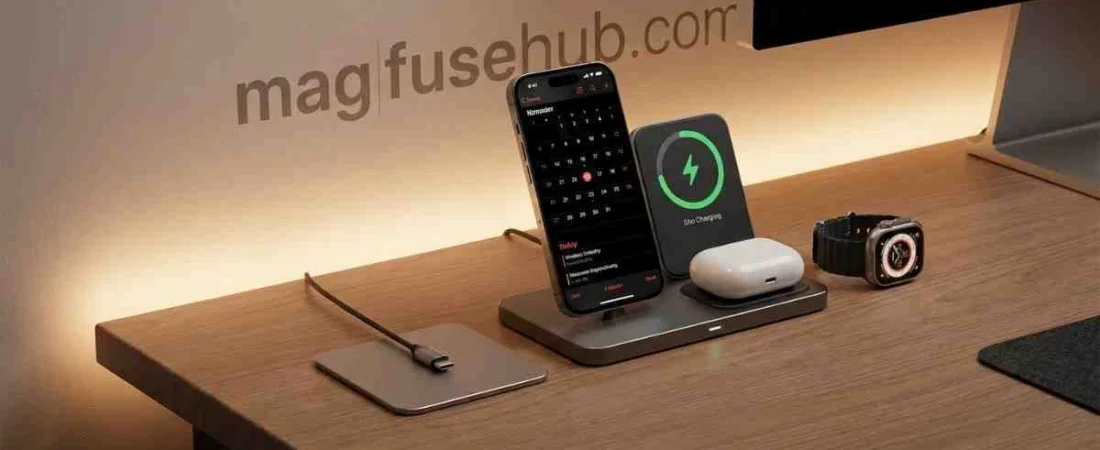
A well-designed desk charging station uses magnetic accessories to create a dedicated charging zone that stays organized without effort. The typical setup includes a primary wireless charging station for the smartphone, a secondary pad or stand for earbuds and smartwatch, and a magnetic charging dock that holds the phone at a viewable angle during charging.
The result is a desktop where every device always knows where it lives. You set it down, it charges, you pick it up. The desk stays clean, the cables stay hidden, and the cognitive overhead of “is my phone charged?” essentially disappears.
For those building a productive home or office environment, pairing a well-organized charging setup with tools that manage your Android device efficiently is equally valuable. If you’re experiencing issues with your Android device while charging — like delayed notifications when your phone is on the charger — the guide at todoandroid.live/android-notification-delay/ offers practical solutions worth reading.
Travel Charging Accessories
Travel to Rochester is where magnetic charging accessories genuinely shine. A portable magnetic power bank with magnetic alignment attaches to the back of your phone and charges it without cables — leaving your hands free and your bag uncluttered. A compact magnetic charging pad handles overnight hotel charging without a tangle of adapters.
The key when selecting travel charging accessories is weight and fold-down cable design. The best travel magnetic chargers integrate the cable directly into the pad body, eliminate the need for a separate power supply where possible, and weigh under 100 grams. Pair these with a universal USB-C travel adapter and you have a complete, compact charging setup for any destination.
Portable Magnetic Power Banks Explained
The portable magnetic power bank is one of the most practically useful innovations in the charging accessories category. Unlike traditional power banks that require you to find the cable, plug it in, and manage the resulting tangle, a magnetic power bank snaps directly to the back of your MagSafe or Qi2-compatible phone and charges it on the go — completely cable-free.
Key specs to evaluate when choosing a magnetic power bank:
- Capacity: 5,000mAh provides roughly 1–1.5 full charges for a typical smartphone. 10,000mAh gives you 2–3 charges. For travel, 10,000mAh is the recommended minimum.
- Output wattage: Higher is better, though magnetic power banks typically max at 7.5–15W depending on the standard.
- Pass-through charging: Can the power bank charge itself while simultaneously charging your phone? This is a useful travel feature.
- Form factor: The thinner and lighter, the more comfortable it is to hold the phone while the power bank is attached.
Fast Wireless Charging Technology: What You Need to Know
Fast wireless charging isn’t a single standard — it’s a family of competing and complementary specifications. Here’s how the main ones compare:
- Qi (Standard): Up to 7.5W for iPhone, up to 10–12W for many Android devices. The universal baseline.
- MagSafe: 15W for iPhone 12 and later. Requires Apple-certified MagSafe charger.
- Qi2: 15W, the open standard bringing MagSafe-equivalent magnetic alignment to Android and other devices. Growing rapidly in adoption.
- Proprietary Fast Wireless (Samsung, OnePlus, etc.): 25–65W on compatible devices with brand-specific chargers. Faster than Qi2 but less universal.
For most users, a Qi2-certified charger from a brand like those featured at magfusehub com hits the sweet spot: fast enough for real-world convenience, compatible with the widest range of modern devices, and future-proofed as Qi2 adoption grows.
How to Build a Clutter-Free Charging Setup
A clean charging setup isn’t just aesthetically pleasing — it’s genuinely more functional. Here’s a step-by-step approach:
Step 1: Audit your devices. List every device that needs daily or regular charging: smartphone, earbuds, smartwatch, tablet, laptop. Identify which standards each device supports.
Step 2: Choose a hub or primary charging station. A multi-device wireless charging station that handles your most frequently charged devices (phone, earbuds, watch) in one spot eliminates the need for separate chargers and cables.
Step 3: Select magnetic accessories for your phone. A magnetic charger for your smartphone is the cornerstone of the setup. Choose one with a stand function so you can still see and interact with your screen while charging.
Step 4: Route cables deliberately. Even a wireless charging setup has power cables running to the charger. Use cable clips or channels to route these behind your desk or nightstand — out of sight and out of mind.
Step 5: Add a portable solution. Keep a portable wireless charger or magnetic power bank charged and ready for days when you’re away from your desk.
Managing charging accessories on your Android device is closely related to managing the device’s battery and background behavior. For anyone running a Samsung, Pixel, or stock Android device, understanding how battery optimization affects your phone is equally important — the relationship between charging habits and background app performance is covered in depth at todoandroid.live/android-notification-delay/.
Safety and Battery Health in Magnetic Charging
A common question: can magnetic chargers damage batteries? The short answer is no — when used with quality, certified accessories.
Wireless charging does generate slightly more heat than wired charging, and sustained heat is a genuine enemy of lithium-ion battery health. However, well-designed magnetic charging accessories include thermal management systems that regulate temperature during the charging cycle. Certified Qi and Qi2 chargers are required to meet specific thermal and power delivery standards.
The risks are primarily associated with uncertified, cheap accessories that skip these protections. A poorly regulated charger can overheat the battery, deliver inconsistent power, or — in extreme cases — pose a safety risk. Sourcing charging accessories from reputable platforms like magfusehub com, which curates certified products, is the practical way to avoid these issues entirely.
Magnetic fields themselves pose no threat to modern smartphone components. The concern about magnets damaging phones is a holdover from the era of magnetic storage media (cassettes, floppy disks, credit card strips). Modern smartphones use flash storage and solid-state components that are entirely unaffected by the relatively weak magnetic fields in charging accessories.
Compatibility: Apple and Android Devices
Magnetic charging compatibility has become more unified thanks to Qi2, but some nuances remain.
iPhone (12 and later): Full MagSafe support at 15W. Also compatible with Qi and Qi2 accessories at lower wattages. MagSafe accessories snap magnetically to the phone directly.
Older iPhones (11 and earlier): Standard Qi charging only, no magnetic alignment. Compatible with any Qi pad, but without the snap-on attachment.
Android (Qi2-certified devices): Growing list of Samsung Galaxy, Google Pixel, and other flagship Android phones. Qi2 delivers 15W magnetic charging with the same alignment quality as MagSafe.
Android (non-Qi2): Standard Qi charging at 5–12W, depending on device and charger. No magnetic alignment unless using a Qi2 or MagSafe case adapter.
One practical solution for Android users without native Qi2 support is a magnetic adapter — a thin ring or case attachment that adds magnetic alignment to any Qi-compatible device, enabling snap-on magnetic accessories without needing a Qi2-native device.
Also worth noting: if you’re managing multiple Android devices and experiencing issues beyond charging — like blocked contacts, notification behavior, or settings organization — the guides at todoandroid.live/find-blocked-numbers-android/ cover a range of Android management topics in depth.
Future Trends in Wireless Charging Technology
The wireless charging space is evolving faster than most people realize. Several trends are worth watching:
Over-the-air wireless charging: Companies are actively developing true long-range wireless power transfer — charging devices from several feet away without any physical contact. Regulatory approvals are the current bottleneck, but the technology is functional in lab conditions.
Higher Qi2 wattages: The current Qi2 ceiling of 15W is expected to increase as the standard evolves, potentially reaching 30–50W for compatible devices in the coming years.
Universal adoption: As USB-C becomes the mandatory standard across devices (enforced by regulation in major markets), the path to full wireless charging standardization becomes clearer. The combination of USB-C for wired and Qi2 for wireless creates a truly universal charging ecosystem for the first time.
Integration into furniture: Wireless charging pads are already integrated into some desks, nightstands, and car interiors. This trend will deepen as the technology becomes more cost-effective to embed.
Real-Life Examples: Magnetic Charging in Action
The Home Office Professional
Sarah works a 10-hour day from her home office. She upgraded to a magnetic charging dock that holds her iPhone at desk angle while charging. Her AirPods case snaps to a secondary magnetic pad. Her desk has two charging cables — one for her laptop, one running to the wireless charging hub. Everything else is cable-free. Her morning routine went from “where’s my phone cable?” to “place phone, pick up coffee.”
The Frequent Traveler
Marcus travels internationally for work. He carries a compact portable magnetic power bank that attaches to the back of his Qi2-compatible Galaxy phone during layovers, keeping it charged without digging for cables. His one USB-C travel adapter handles the laptop and the wireless pad’s power supply. His entire charging kit fits in a small pouch the size of a passport.
The Tech-Savvy Student
Priya uses her phone heavily throughout the day — lectures, note-taking, music, social media. She has a magnetic charging pad on her nightstand and another on her study desk. Her phone charges passively throughout the day whenever she sets it down. She replaced a dead battery caused by years of poor charging habits with a consistent wireless routine — and her current battery holds 94% health after two years.
Pros and Cons of Magnetic Charging Accessories
Pros
- Effortless charging experience — magnetic alignment removes all friction from the charging process
- Clutter-free desk and nightstand — no cables sprawling across surfaces
- Fast charging support — 15W via MagSafe and Qi2 covers most daily charging needs efficiently
- Portable and travel-friendly — magnetic power banks and compact pads are genuinely useful on the go
- Reduced port wear — extends the physical lifespan of your device’s charging port
- Snap-on accessory ecosystem — MagSafe and Qi2 open the door to a wide range of accessories beyond charging
Cons
- Compatibility limitations — older devices and some Android phones require adapters for magnetic alignment
- Charging speed ceiling — wired fast charging (65W+) still outpaces wireless for speed-critical situations
- Premium accessory pricing — quality magnetic charging accessories cost more than basic wired cables
- Device-specific ecosystems — some accessories are optimized for either Apple or Android, not both
- Heat sensitivity — wireless charging produces more heat than wired; poor-quality accessories can exacerbate this
Frequently Asked Questions
What is magfusehub com?
magfusehub com is an online platform specializing in magnetic charging accessories, MagSafe-compatible products, wireless charging stations, and portable charging solutions for smartphones and modern devices.
What are magnetic charging accessories?
Magnetic charging accessories are charging products that use magnets to align and connect charging coils with compatible devices. They include wireless charging pads, magnetic charging cables, portable power banks, and charging docks that snap onto MagSafe or Qi2-compatible devices.
How does MagSafe charging work?
MagSafe uses a ring of precisely arranged magnets inside compatible iPhones to automatically align a magnetic charging pad with the device’s internal charging coil. This ensures consistent, efficient wireless power delivery at up to 15W without any manual positioning.
Are magnetic chargers safe for smartphones?
Yes, when using certified accessories. Quality magnetic chargers include thermal management and power regulation that keep charging safe and battery-healthy. The magnetic fields involved are too weak to affect modern smartphone components or storage.
What is the best wireless charging station?
The best wireless charging station depends on your devices. For iPhone users, a MagSafe-certified multi-device stand covers phone, watch, and earbuds. For Android users, a Qi2-certified station offers the same magnetic alignment experience. Look for 15W output, multi-device support, and a design that fits your desk or nightstand.
Do magnetic chargers charge faster?
MagSafe and Qi2 magnetic chargers reach 15W — significantly faster than standard Qi wireless charging (7.5–10W) but slower than top-tier wired fast charging. For daily use, 15W wireless is fast enough to fully charge most phones overnight or top up meaningfully in 30–60 minutes.
What are the benefits of magnetic charging?
The primary benefits are convenience (no cable fumbling), consistent alignment (full charging speed every time), port longevity (no physical connector wear), cable management simplicity, and compatibility with a growing ecosystem of snap-on accessories.
Can magnetic chargers damage batteries?
No, provided you’re using certified accessories. Quality magnetic chargers manage heat and power delivery within safe parameters. The main battery risk comes from uncertified accessories that skip these protections — which is why sourcing from reputable platforms matters.
How do wireless charging stations work?
Wireless charging stations use electromagnetic induction. A coil in the charging pad generates an alternating magnetic field. A corresponding coil inside the device converts this field into electrical current, which charges the battery. Magnetic alignment systems ensure the coils are positioned optimally for maximum efficiency.
Are magnetic charging cables worth it?
For users who frequently connect and disconnect devices — particularly laptops and tablets — magnetic charging cables offer genuine benefits: clean disconnection under tension, reduced port wear, and faster plug-in. For phones where wireless charging is available, a magnetic pad is typically more convenient than a magnetic cable.
What devices support magnetic charging?
iPhone 12 and later natively support MagSafe magnetic charging. A growing list of Android flagships support Qi2 magnetic charging. Older devices can gain magnetic alignment through compatible case adapters.
How do I choose the best wireless charger?
Match the charger’s output to your device’s supported standard (MagSafe = 15W for iPhone, Qi2 for Android, Qi for older devices). Verify build quality and certification. Consider whether you need a portable or desk design, and check whether a power adapter is included.
What is the difference between MagSafe and wireless charging?
Standard wireless charging (Qi) transfers power without magnetic alignment — placement must be approximate. MagSafe adds a magnetic ring that snaps the charger into perfect alignment automatically, enabling faster charging speeds and a more reliable connection. Qi2 brings the same magnetic alignment to Android devices.
Are portable magnetic power banks reliable?
Yes, for most daily use cases. Quality portable magnetic power banks offer consistent charging at 7.5–15W, reasonable capacity (5,000–10,000mAh), and durable magnetic attachment. They’re ideal for keeping your phone charged during travel or long days away from an outlet.
What are the best charging accessories for iPhone?
For iPhone 12 and later: a MagSafe-certified 15W wireless charger for desk use, a portable magnetic power bank for on-the-go charging, and a MagSafe multi-device station for nightstand use. All available through specialized platforms like magfusehub com.
Conclusion
The shift toward magnetic and wireless charging isn’t a passing trend — it’s a fundamental improvement in how we interact with our devices every day. The friction of cables, misaligned chargers, and worn-out ports is being replaced by something cleaner, faster, and more intuitive. magfusehub com represents exactly the kind of focused, product-curated platform that makes navigating this technology accessible to everyday users — whether you’re building your first wireless charging setup or upgrading an existing one.
From fast wireless charging standards like MagSafe and Qi2, to portable magnetic power banks that eliminate cables entirely, to multi-device desk stations that bring order to a cluttered workspace, the magnetic charging accessories available today are mature, reliable, and genuinely worth adopting.
The best charging setup is one you don’t have to think about. You put your phone down. It charges. You pick it up. That’s the promise of magnetic charging technology — and it’s one that magfusehub com is built to deliver.
Ready to upgrade your charging experience? Explore the full range of magnetic charging accessories, MagSafe solutions, and wireless power products at magfusehub com — and build the clutter-free, fast, effortless charging setup your devices deserve.
Found this guide useful? Share it with someone still wrestling with tangled cables, or drop a comment below about your current charging setup. What’s the one accessory that made the biggest difference for you?
Related Reading on Android & Smartphone Management:
- Android Notification Delay: Causes, Fixes & Solutions — if your phone isn’t alerting you properly while charging, this guide covers every fix
- How to Find Blocked Numbers on Android — manage your Android device settings alongside your charging setup
- getoptiglasses.com: Premium Eyewear for Screen Users — if you’re spending long hours near screens and chargers, eye protection matters too