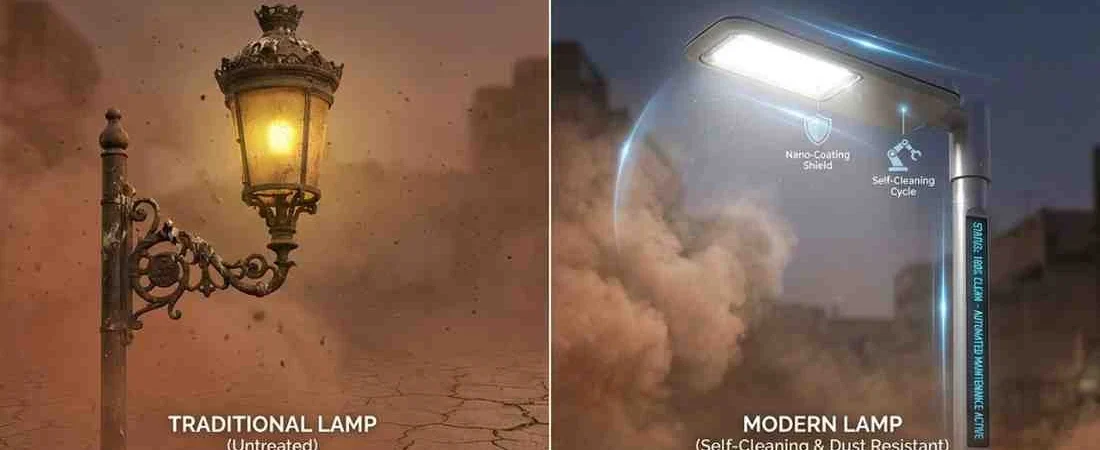
What Is a Self Cleaning Street Lamp?
A self cleaning street lamp is an outdoor lighting fixture engineered to remove dust, dirt, and environmental contaminants from its surface automatically — without manual intervention. Instead of relying on scheduled maintenance crews, these lamps use built-in mechanisms such as hydrophobic coatings, electrostatic systems, or compressed air to keep optical surfaces clean and light output consistent.
The concept emerged from a straightforward problem: dust accumulation on street lamp lenses can reduce luminous output by 20–40% over time, wasting energy and degrading public safety. Self cleaning technology addresses this directly.
Key characteristics of a self cleaning street lamp include:
- Automated cleaning cycles triggered by sensors or timers
- Dust-repellent surface coatings that prevent particle adhesion
- Sealed, dust proof housing rated to IP65 or higher
- Integration with smart city infrastructure for remote monitoring
Does a Dust Resistant Street Lamp Project Exist?
Yes — self cleaning street lamp research and dust resistant lamp projects are real and actively developing across multiple countries. This is not speculative technology. Several documented initiatives confirm active development and field deployment.
What Projects Have Been Researched or Developed?
Several research programs and commercial projects have addressed dust resistant outdoor LED street lamp design:
- Academic research institutions in China, India, and the Middle East have published peer-reviewed studies on electrostatic dust removal systems applied to solar panels and outdoor lighting fixtures, given the acute dust problem in arid and high-pollution urban environments.
- Solar street lamp manufacturers — particularly those serving Middle Eastern and South Asian markets — have integrated hydrophobic nano-coatings onto lamp housings and lens covers as a standard feature in premium product lines.
- NASA and ESA-derived research on electrostatic dust removal for solar panels in space and desert environments has directly informed terrestrial applications in outdoor lighting.
While a single globally recognized “self cleaning street lamp project” with that exact branding does not dominate the field, the underlying technology is distributed across multiple active research streams and commercial product lines.
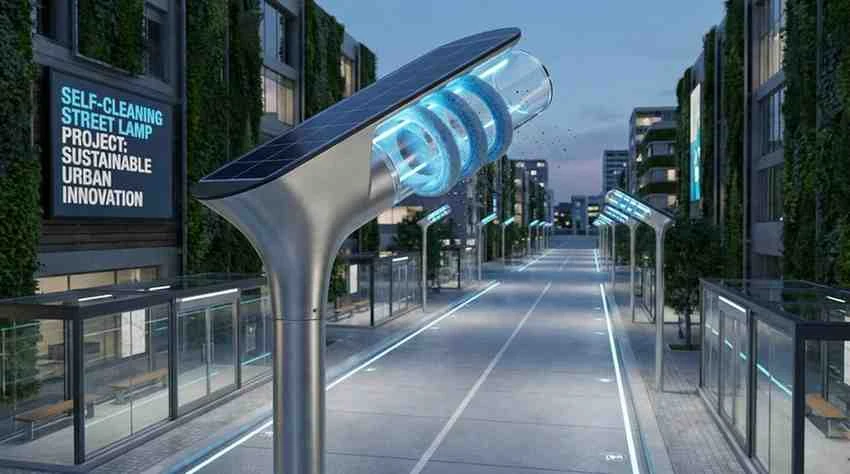
How Does Automated Street Lamp Cleaning Work?
Automated street lamp cleaning works through one or more of four primary mechanisms, often combined in advanced intelligent street lighting systems.
Hydrophobic and Photocatalytic Surface Coatings
The most widely deployed method applies nano-scale coatings — typically titanium dioxide (TiO₂) or silica-based compounds — to lamp covers and housings. These coatings work in two ways:
- Hydrophobic action causes water to bead and roll off the surface, carrying loose dust particles with it during rain or condensation events.
- Photocatalytic action (in TiO₂ coatings) uses UV light to break down organic contaminants at the surface, effectively self-sterilizing and self-cleaning in sunlight.
These coatings require no power and add minimal cost, making them the most commercially mature solution.
Electrostatic Dust Removal Systems
Electrostatic systems generate a low-voltage electric field around the lamp surface. Dust particles, which carry a natural charge, are repelled from or collected onto a separate electrode strip rather than settling on the optical lens. This approach is well-documented in solar panel research and is being adapted for outdoor LED street lamp applications in high-dust environments.
Compressed Air and Mechanical Wiping
Some prototype designs incorporate small compressed air jets or mechanical wiping blades — similar in concept to automotive windshield systems — that activate on a programmed schedule or in response to dust sensor readings. These systems are more mechanically complex and are currently found in research prototypes rather than mainstream commercial products.
IP-Rated Sealed Housing
A foundational layer of dust resistance comes from the enclosure itself. Lamps rated IP65 or IP66 are fully dust-tight by international standard, preventing ingress that would require internal cleaning. Combined with surface coatings, sealed housing forms the baseline of any dust proof street light design.
Also Read: this-game-cannot-be-played-by-a-player-from-cao
What Technologies Make Smart Street Lighting Dust Resistant?
Modern smart street lighting systems use a layered technology stack to minimize dust impact and extend maintenance intervals.
- IoT sensors monitor particulate matter levels around the lamp and trigger cleaning cycles or maintenance alerts when thresholds are exceeded
- Nano-coated lens covers with hydrophobic or photocatalytic properties reduce particle adhesion continuously
- High-efficiency LED arrays with tightly sealed optical chambers maintain lumen output even as external surfaces experience minor soiling
- Remote monitoring platforms log lumen depreciation data over time, allowing predictive maintenance scheduling rather than calendar-based cleaning rounds
- Solar-integrated designs on solar street lamp technology products often combine dust-repellent panel coatings with smart charge controllers, addressing dust impact on both energy generation and light output simultaneously
The combination of these technologies defines what the industry terms an intelligent street lighting system — one that manages its own performance with minimal human intervention.
What Are the Benefits of Self Cleaning Street Lamps?
Self cleaning street lamps deliver measurable advantages across energy efficiency, cost, and urban safety.
Energy efficiency: Clean lenses transmit more light. Maintaining optical cleanliness prevents the lumen depreciation that forces operators to over-specify lamp wattage as a buffer against soiling losses. Energy efficient street lamps that stay clean consume less power per unit of useful illumination delivered.
Reduced maintenance costs: Manual lamp cleaning in large urban networks is expensive. Labour, vehicle access, and traffic management costs compound quickly across thousands of fixtures. Automated or self-maintaining systems reduce cleaning frequency by 50–70% in documented pilot programs.
Improved public safety: Consistent light output along roads and pedestrian areas directly relates to accident reduction and crime deterrence. Soiled lamps create uneven illumination that undermines both.
Extended equipment lifespan: Dust and particulate contamination accelerates thermal degradation inside lamp housings. Keeping surfaces clean reduces heat buildup and extends LED driver and component life.
Sustainability: Lower maintenance vehicle deployment reduces carbon emissions. Longer service intervals reduce replacement component manufacturing demand. Both support sustainable street lighting goals in urban infrastructure planning.
What Challenges Do Traditional Street Lights Face?
Understanding the problem helps frame why self cleaning and dust resistant innovations matter.
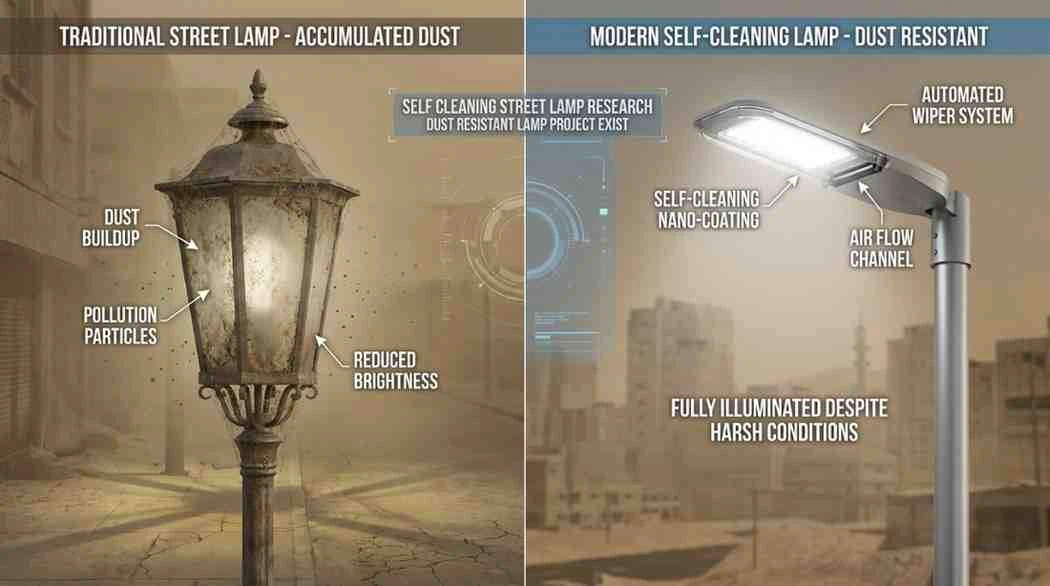
Traditional outdoor street lamps face four compounding challenges:
- Dust and particulate accumulation — In urban, industrial, and arid environments, lenses accumulate grime rapidly. Output degradation of 20–40% within 12–18 months of installation is commonly reported without cleaning.
- High maintenance costs — Cleaning and relamping operations require specialized access equipment, trained crews, and traffic management, making routine maintenance expensive per fixture.
- Energy waste — Degraded lumen output leads to higher energy consumption for equivalent illumination, or under-lit streets where safety is compromised.
- Reactive rather than predictive maintenance — Traditional systems have no self-monitoring capability. Maintenance is calendar-driven or failure-driven, both of which are inefficient models for urban lighting solutions at scale.
These challenges are acute in rapidly urbanizing regions in Asia, the Middle East, and Africa, where pollution levels are high and maintenance infrastructure is under strain — precisely the markets where dust resistant street lamp research has the most urgency.
Also Read: messeregge
How Do Self Cleaning Street Lamps Support Smart Cities?
Self cleaning street lamps are a natural component of smart city lighting infrastructure because they align with the core smart city principles of autonomy, data integration, and resource efficiency.
In a smart city context, these lamps contribute in several ways:
- Reduced operational burden on city maintenance departments, freeing resources for higher-priority infrastructure needs
- Data generation through integrated sensors monitoring air quality, light levels, and equipment health, feeding into city-wide environmental dashboards
- Grid efficiency by maintaining consistent energy consumption profiles — a clean lamp draws predictable power, while a soiled one draws more for less output
- Citizen safety through reliable, consistent illumination without service gaps caused by degraded fixtures
Advanced street lamp design that incorporates self cleaning features is increasingly specified in smart city tenders, particularly in GCC countries, Southeast Asia, and European urban renewal programs where intelligent infrastructure is a stated policy goal.
What Does the Future of Dust Resistant Lighting Look Like?
The trajectory of self cleaning street lamp research points toward greater autonomy, lower cost, and broader deployment.
Near-term (1–5 years): Hydrophobic and photocatalytic coatings will become standard on premium outdoor LED street lamp products. IP67-rated sealed designs will displace older IP65 specifications in new installations.
Medium-term (5–10 years): Electrostatic dust removal systems will move from research prototypes to commercial products, particularly for solar street lamp technology applications in desert and high-pollution environments where energy loss from dust is most economically damaging.
Longer-term: Fully autonomous maintenance systems combining AI-driven monitoring, predictive cleaning cycle activation, and self-reporting fault detection will integrate into city-wide smart city infrastructure platforms. Self maintenance technology in lighting will mirror developments already underway in autonomous building management systems.
The overarching direction is clear: low maintenance street lights that manage their own performance are becoming an infrastructure standard, not a premium option.
Also Read: magfusehub-com
FAQs About Self Cleaning Street Lamp Research
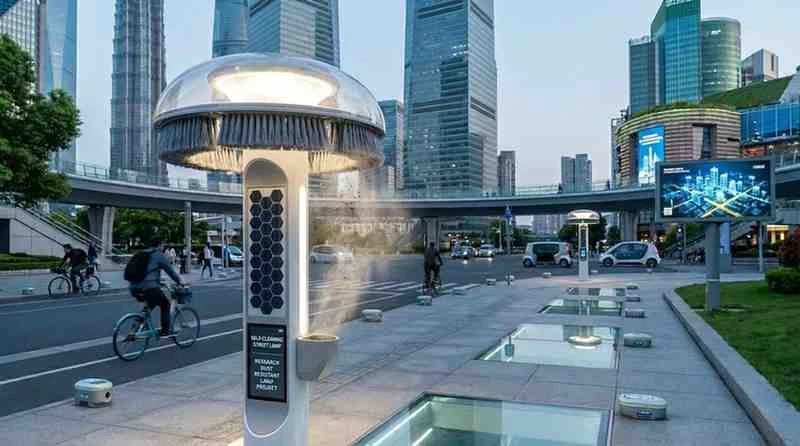
What is a self cleaning street lamp? A street lamp engineered to remove dust and contaminants automatically using coatings, electrostatic systems, or mechanical methods — maintaining light output without manual cleaning intervention.
Does a dust resistant street lamp project exist? Yes. Multiple research programs and commercial product lines address dust resistance in outdoor LED and solar street lamp technology, particularly in markets with high air pollution and dust exposure.
How does automated street lamp cleaning work? Through hydrophobic coatings, photocatalytic surface treatments, electrostatic dust repulsion, or sensor-triggered mechanical cleaning — often combined in a single intelligent street lighting system.
Are self cleaning street lamps energy efficient? Yes. Maintaining clean optical surfaces prevents lumen depreciation, reducing energy consumption per unit of useful light output compared to soiled conventional fixtures.
Can dust resistant lamps reduce maintenance costs? Documented pilot programs report cleaning frequency reductions of 50–70%, with corresponding labour and operational cost savings across large urban lighting networks.
Are these lamps useful in polluted cities? They are most valuable precisely in high-pollution urban environments where dust accumulation rates are highest and the performance gap between cleaned and uncleaned fixtures is most significant.
What is the future of self maintenance technology in lighting? Progressive integration of IoT sensors, AI-driven predictive maintenance, and advanced surface coatings — moving toward fully autonomous public lighting solutions that require minimal human intervention.
Final Thoughts: Self Cleaning Street Lamp Research Is Real and Advancing
Self cleaning street lamp research and dust resistant lamp projects are not theoretical. They represent an active and commercially advancing field driven by real urban infrastructure challenges — dust accumulation, rising maintenance costs, energy waste, and the demands of smart city development.
The technology exists today in the form of nano-coatings, IP-rated sealed enclosures, and sensor-integrated intelligent street lighting. It is maturing toward fully autonomous systems that will define the next generation of urban lighting solutions.
If you are specifying outdoor LED street lamp products, evaluating smart city lighting tenders, or researching sustainable urban infrastructure, understanding self cleaning and dust resistant lamp technology is increasingly relevant to making informed decisions.
Found this useful? Share this article with your network or leave a comment below with your questions about smart street lighting technology.