As data center networks move toward higher-speed connectivity, 800G has become an important interface speed for high-bandwidth switches and AI infrastructure. An 800G DAC cable provides a direct copper connection between compatible 800G ports, allowing devices within short distances to exchange data without separate optical transceivers and fiber patch cables. This makes DAC an option for applications where high bandwidth is required but the connection distance is very short.
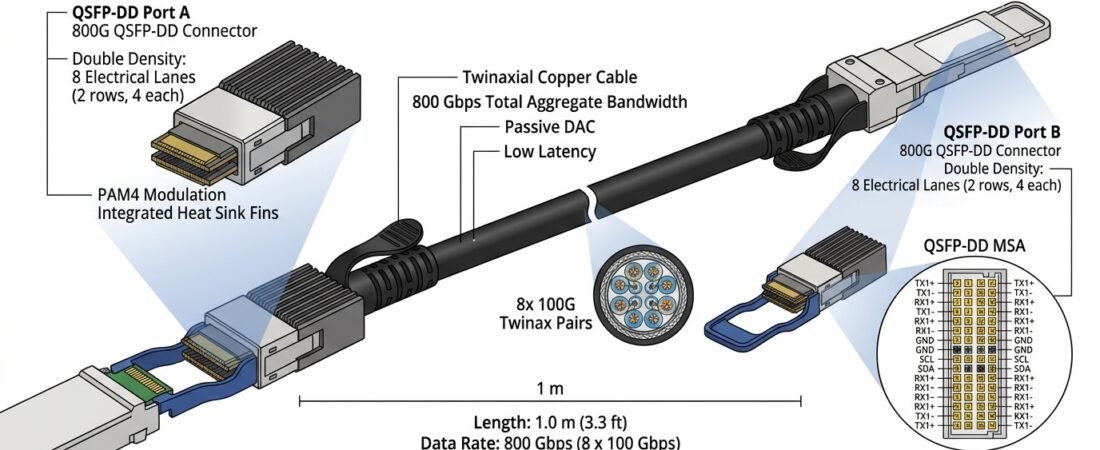
An 800G QSFP-DD to QSFP-DD DAC consists of a QSFP-DD connector on each end and a passive twinaxial copper cable between them. Both ends are designed to connect directly to compatible 800G QSFP-DD switch or network ports. Unlike an optical link, the cable does not convert electrical signals into optical signals for transmission through fiber. Instead, high-speed electrical signals travel directly through the copper conductors.
But what do “800G,” “QSFP-DD,” “passive,” and “twinax” actually mean? Understanding these terms helps explain how this type of cable works, where it can be deployed, and when a short copper connection may be more practical than an optical solution.
What Is an 800G QSFP-DD to QSFP-DD DAC?
An 800G QSFP-DD to QSFP-DD DAC is a direct attach copper cable designed to connect two compatible 800G QSFP-DD interfaces. The cable integrates the connector assemblies with the copper cable, creating a complete direct connection between two network ports.
Understanding the 800G Specification
The 800G designation refers to the aggregate data rate supported by the connection. An 800G interface can provide up to 800Gb/s of bandwidth when the connected equipment and cable support the required electrical signaling and configuration.
For data center switches, this high port bandwidth can reduce the number of physical connections needed to move large amounts of traffic. It is particularly relevant to high-performance computing, AI infrastructure, and other environments where network traffic between switches and compute resources continues to increase.
The actual supported data rate depends on the host equipment, port configuration, cable specification, and other system-level factors. Therefore, an 800G DAC should always be deployed with equipment that supports the corresponding interface and electrical requirements.
What Does QSFP-DD Mean?
QSFP-DD refers to a high-density pluggable form factor used for high-speed networking. The “DD” represents the double-density electrical interface architecture, which provides more electrical lanes than earlier QSFP generations.
QSFP-DD at Both Ends
In an 800G QSFP-DD DAC, both cable ends use QSFP-DD connectors. This allows the cable to connect two compatible QSFP-DD ports directly without requiring separate optical modules.
The QSFP-DD interface provides the physical and electrical connection between the host device and the cable. Inside each connector assembly, the electrical signals are organized into multiple high-speed lanes. The combined lanes provide the bandwidth required for the 800G connection.
Compatibility is important because not every QSFP-DD port necessarily supports every signaling rate or cable type. Before installation, users should verify the switch specifications and the cable’s supported electrical interface.
How Does a Passive 800G DAC Work?
The word “passive” describes an important characteristic of this cable. A passive DAC does not contain active signal amplification or optical conversion components in the transmission path.
Direct Electrical Signal Transmission
When a switch sends data through an 800G passive DAC, the electrical signals travel directly from the transmitter circuitry in one QSFP-DD port through the copper cable to the receiving circuitry at the other end. There is no electrical-to-optical conversion and no optical-to-electrical conversion.
The simplified signal path is:
Switch → QSFP-DD → Twinax Copper → QSFP-DD → Switch
This straightforward architecture is one reason passive DACs are commonly used for very short connections. Because the cable does not need to perform optical conversion or active signal processing, the overall connection can be relatively simple.
However, passive copper transmission is inherently more sensitive to distance than optical transmission. As the cable becomes longer, electrical attenuation and signal integrity challenges become increasingly important. For this reason, passive DACs are generally intended for short-reach applications.
Why Does the Cable Use Twinax Copper?
Twinax is short for twinaxial cable, a type of copper cable designed for high-speed differential electrical signaling. It contains paired conductors arranged with shielding to help control electromagnetic interference and maintain signal integrity.
Twinax for High-Speed Short Links
High-speed networking requires the electrical signal to remain sufficiently clear as it travels between devices. Twinax construction is well suited to short-distance applications because it can provide a controlled electrical environment for high-speed differential signals.
For an 800G passive DAC, maintaining signal integrity is particularly important because the aggregate bandwidth is high and the electrical lanes operate at high data rates. Cable construction, connector quality, insertion loss, and the characteristics of the host ports all contribute to overall link performance.
Why Use a 0.5m 800G DAC?
A 0.5m, or approximately 2ft, DAC is designed for extremely short connections. This length can be useful when two compatible network devices are installed close to each other, such as within the same rack or between adjacent equipment positions.
Short Connections and Cable Management
Using a cable that closely matches the required distance can help reduce unnecessary cable slack. In high-density racks, excessive cable length can make cable management more difficult and occupy valuable space around network ports.
A 0.5m DAC can therefore be practical for direct switch-to-switch or other equipment-to-equipment connections where the physical distance is limited. The exact application depends on the equipment layout and the supported cable reach.
800G DAC vs. Optical Connectivity
The choice between an 800G DAC and an optical solution largely depends on the required distance and deployment environment. DAC uses copper and provides a direct electrical connection, making it well suited to short links. Optical connectivity uses transceivers and fiber to transmit data over greater distances.
For a very short connection, a passive DAC can simplify the physical link because the cable combines the connectors and transmission medium into one assembly. For longer connections, optical transceivers and fiber cables provide greater reach and are generally more appropriate.
The choice is therefore not simply about bandwidth. Both solutions may support 800G, but their physical transmission media, reach, power characteristics, and deployment requirements are different.
Where Are 800G QSFP-DD DAC Cables Used?
800G QSFP-DD DAC cables are primarily suited to short-distance high-speed connections between compatible networking devices. Applications can include connections between switches in the same rack, high-bandwidth links between adjacent network equipment, and other environments where the required cable length is short.
Supporting High-Density Data Centers
As data center switch port speeds increase, short copper interconnects can remain useful for connections where optical reach is unnecessary. In AI and high-performance computing environments, this can be relevant for high-bandwidth connections within densely populated racks.
Because the cable is passive, however, users should pay close attention to the specified reach and compatibility requirements. A short DAC should not be substituted for a longer optical link simply because both interfaces support the same nominal bandwidth.
Conclusion
An 800G QSFP-DD to QSFP-DD DAC is a high-speed direct attach copper solution designed to connect two compatible 800G QSFP-DD ports. Its passive twinax construction allows electrical signals to travel directly between the connected devices without optical conversion.
For very short connections such as a 0.5m link, this architecture can provide a straightforward approach to high-bandwidth connectivity. The combination of 800G bandwidth, QSFP-DD interfaces, twinax copper, and a compact cable length makes it suitable for short-reach connections in high-density data center environments.
The key point is that 800G DAC is not intended to replace optical connectivity in every application. Instead, it provides a practical option when two compatible 800G ports are located close enough for a passive copper connection. Selecting the right solution ultimately depends on the required bandwidth, distance, port compatibility, and physical layout of the network.