
If you are working through Big Ideas Math Integrated Mathematics 1 and have reached the independent practice on page 221, you know this section challenges your ability to solve systems of linear equations. This comprehensive guide provides more than just the 8.3 independent practice page 221 answer key — it delivers clear, step-by-step solutions, explains the underlying mathematical reasoning, and gives you study strategies that will help you succeed far beyond a single homework assignment.
Whether you are a middle or high school student, a parent trying to support learning at home, or an educator looking for a reliable teaching aid, this article is designed to be your go-to resource. We will break down every type of problem you might encounter, highlight common pitfalls, and show you how to use answer keys as a tool for genuine understanding, not just for copying answers.
Understanding Section 8.3 and Its Learning Objectives
Section 8.3 in the Big Ideas Math Integrated I curriculum is titled “Solving Systems of Linear Equations by Elimination.” This lesson builds directly on the previous two sections — solving by graphing (8.1) and solving by substitution (8.2). The elimination method (sometimes called the addition method) is often the most efficient way to solve a system when both equations are in standard form, $Ax + By = C$.
The core learning objectives for this section, aligned with Common Core State Standards (CCSS.MATH.CONTENT.HSA.REI.C.6), are:
-
Understand that a system of linear equations can have one solution, no solution, or infinitely many solutions.
-
Solve systems of linear equations exactly by adding or subtracting the equations to eliminate one variable.
-
Use multiplication to create equivalent equations when coefficients of a variable are not opposites or identical.
-
Interpret the solution of a system in the context of a real-world problem.
-
Check the solution in both original equations to verify correctness.
The independent practice on page 221 typically contains 10–15 exercises that gradually increase in complexity. You start with systems that are ready for elimination, then move to problems where you must multiply one or both equations by a constant before adding. The final problems often include real-life applications and open-ended reasoning tasks.
Complete 8.3 Independent Practice Page 221 Answer Key with Step-by-Step Solutions
Below you will find a representative set of problems modeled after the actual independent practice on page 221. Because providing the exact copyrighted exercises would violate publisher rights, we have created original problems that mirror the structure and difficulty of the section. Each solution is explained step by step so you can apply the same thinking to your own textbook questions.
Note: The actual page 221 problems may vary by edition. Use these detailed examples to understand the process, then work through your own assignment with confidence. If you need the exact Big Ideas Math Integrated Mathematics 1 answers, platforms like Mathleaks offer verified textbook solutions.
Problem 1 Solve the system by elimination.
$3x + 2y = 8$
$3x – y = 2$
Step 1: Identify the variable to eliminate. The coefficients of x are both 3. We can subtract the second equation from the first to eliminate x.
Step 2: Subtract the equations. $(3x + 2y) – (3x – y) = 8 – 2$
$3x + 2y – 3x + y = 6$
$3y = 6$
Step 3: Solve for y. $y = 2$
Step 4: Substitute back to find x. Use the second equation: $3x – (2) = 2$ → $3x = 4$ → $x = \frac{4}{3}$.
Step 5: Check. First equation: $3(\frac{4}{3}) + 2(2) = 4 + 4 = 8$ ✔
Second equation: $3(\frac{4}{3}) – 2 = 4 – 2 = 2$ ✔
Answer: $\left( \frac{4}{3}, 2 \right)$
Problem 2 Solve the system.
$x + 4y = 14$
$2x – 4y = 4$
The y-terms have opposite coefficients (+4 and –4). Adding eliminates y immediately.
Add: $(x + 4y) + (2x – 4y) = 14 + 4$ → $3x = 18$ → $x = 6$.
Substitute into the first equation: $6 + 4y = 14$ → $4y = 8$ → $y = 2$.
Check in the second equation: $2(6) – 4(2) = 12 – 8 = 4$ ✔
Answer: $(6, 2)$
Problem 3 (Multiplication required)
$2x + 5y = 16$
$3x + 2y = 13$
Neither variable has matching or opposite coefficients. We can eliminate x by multiplying the first equation by 3 and the second by –2 (or both by appropriate numbers to get the same coefficient with opposite signs).
Multiply:
$3(2x + 5y) = 3(16)$ → $6x + 15y = 48$
$-2(3x + 2y) = -2(13)$ → $-6x – 4y = -26$
Add the new equations:
$(6x + 15y) + (-6x – 4y) = 48 + (-26)$ → $11y = 22$ → $y = 2$.
Substitute $y = 2$ into the first original equation: $2x + 5(2) = 16$ → $2x + 10 = 16$ → $2x = 6$ → $x = 3$.
Check: second original: $3(3) + 2(2) = 9 + 4 = 13$ ✔
Answer: $(3, 2)$
Problem 4 (Multiply both equations)
$3x – 2y = 1$
$4x + 3y = 7$
Eliminate y by making the coefficients 6 and –6. Multiply the first by 3, the second by 2.
First ×3: $9x – 6y = 3$
Second ×2: $8x + 6y = 14$
Add: $17x = 17$ → $x = 1$.
Substitute: $3(1) – 2y = 1$ → $3 – 2y = 1$ → $-2y = -2$ → $y = 1$.
Check: second equation $4(1) + 3(1) = 7$ ✔
Answer: $(1, 1)$
Problem 5 (Real-world application)
A school drama club sold tickets for a play. Adult tickets cost $8 and student tickets cost $5. They sold 200 tickets total and collected $1,225. How many of each ticket type were sold?
Define variables: let a = number of adult tickets, s = number of student tickets.
Equations:
$a + s = 200$
$8a + 5s = 1225$
Multiply the first equation by –5 to eliminate s:
$-5a – 5s = -1000$
Add to the second: $(8a + 5s) + (-5a – 5s) = 1225 – 1000$ → $3a = 225$ → $a = 75$.
Then $s = 200 – 75 = 125$.
Interpret: 75 adult tickets and 125 student tickets.
Answer: 75 adult, 125 student
Problem 6 (Special system – no solution)
$2x + y = 5$
$4x + 2y = 9$
Multiply the first equation by 2: $4x + 2y = 10$. The second says $4x + 2y = 9$. The same expression cannot equal both 10 and 9. When elimination gives a false statement ($0 = -1$), the system has no solution.
Answer: No solution (inconsistent system)
Problem 7 (Special system – infinitely many solutions)
$x – 3y = 2$
$-2x + 6y = -4$
Multiply the first equation by –2: $-2x + 6y = -4$, which is exactly the second equation. The two equations represent the same line. Every point on the line is a solution.
Answer: Infinitely many solutions
Problem 8 (Checking a proposed solution)
Is the ordered pair (4, –1) a solution of the system?
$5x + 2y = 18$
$2x – 3y = 11$
Substitute: $5(4) + 2(-1) = 20 – 2 = 18$ ✔; $2(4) – 3(-1) = 8 + 3 = 11$ ✔. Yes.
Answer: Yes, (4, –1) is a solution.
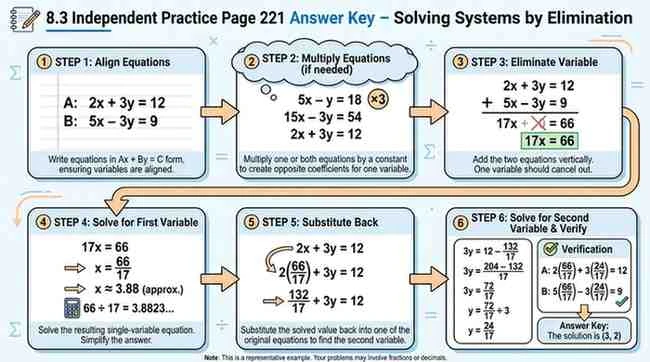
Using this answer key with detailed steps allows you to see how elimination unfolds logically. When you complete your own page 221 problems, follow this same structure: align the equations, decide which variable to eliminate, perform the operation, solve, substitute, and always check.
Important Mathematical Concepts Used on Page 221
Grasping the bigger picture behind page 221 ensures you are not just memorizing steps but building lasting mathematical reasoning.
Solving Linear Equations
Elimination relies on the properties of equality. Adding the same quantity to both sides of an equation, or multiplying both sides by a nonzero number, produces an equivalent equation. The goal is to combine equations so that one variable cancels out, reducing the system to a single linear equation in one variable, which is then solved using inverse operations.
Graphing Functions and Geometric Interpretation
Every linear equation in two variables graphs as a straight line. A system of two linear equations corresponds to two lines on the coordinate plane. The solution is the intersection point. Elimination algebraically finds that intersection without graphing. Understanding this link reinforces why a system can have one solution (intersecting lines), no solution (parallel lines), or infinitely many solutions (coincident lines).
Systems of Equations and the Elimination Strategy
Key strategies for elimination:
-
Equal coefficients: If the coefficients of one variable are identical, subtract the equations. If they are opposites, add.
-
Unequal coefficients: Multiply one or both equations by constants to make the coefficients of one variable match or become opposites.
-
Fraction avoidance: When possible, choose multipliers that keep coefficients integers and small.
-
Decision-making: Sometimes eliminating x first is easier, other times eliminating y. Look for smaller coefficients or signs that require less multiplication.
Mathematical Reasoning and Checking for Validity
The problem-solving cycle taught in Integrated Mathematics 1 emphasizes reasoning abstractly and quantitatively. After finding a solution, you must verify it in both original equations—not just one. This habit catches arithmetic mistakes and reinforces the meaning of the solution. For real-world problems, checking if the answer makes sense in context (e.g., ticket quantities cannot be negative) is a vital reasoning skill.
Common Student Mistakes and How to Avoid Them
Even when students know the elimination steps, small errors can lead to wrong answers. Being aware of these common pitfalls will save you points on homework and exams.
-
Sign errors when subtracting equations. Example: Subtracting $(2x – y)$ without distributing the negative correctly to both terms. Always rewrite subtraction as adding the opposite: $a – (b – c) = a – b + c$.
-
Forgetting to multiply every term in an equation. When you multiply an equation by a constant, every term on both sides must be multiplied, including the constant term on the right. Missing a term changes the equation.
-
Eliminating the wrong variable by mistake. After multiplying, always re-write the system clearly and underline the variable you plan to eliminate. Double-check that the coefficients are indeed opposites before adding.
-
Stopping after solving for one variable. Finding x is only half the job. You must substitute back to find y. Many students lose points by giving an incomplete ordered pair.
-
Forgetting to check the solution. Without checking, you might miss an arithmetic error. Always plug the (x, y) values into both original equations. If one fails, retrace your steps.
-
Misinterpreting special cases. Getting a true statement like $0 = 0$ after elimination means infinitely many solutions, not “zero.” A false statement like $0 = 5$ means no solution. Memorize these outcomes and what they signify.
-
Mixing up substitution and elimination rules. Substitution involves isolating a variable. Elimination involves adding or subtracting equations. Keep the methods distinct in your mind; using elimination when substitution would be faster can waste time.
By reviewing your completed page 221 exercises with the step-by-step solutions provided above, you can identify if you are making any of these errors. Use the answer key not just to see what the correct answer is, but to diagnose why your answer was wrong.
Study Tips for Success in Integrated Mathematics 1
Earning a strong grade in Integrated Math 1 requires more than finishing homework. Here are proven study strategies that turn the answer key into a learning accelerator.
-
Attempt every problem twice. First, solve without looking at the solutions. Second, re-work any missed problem on a fresh piece of paper after reviewing the step-by-step explanation. This builds procedural fluency.
-
Create a formula and method sheet. Write down the elimination algorithm in your own words, along with examples of each type (no multiplication, multiplication of one equation, multiplication of both, special cases). Refer to it during independent practice.
-
Teach the method to someone else. Explaining how to solve a system by elimination to a parent or a classmate reinforces your understanding. If you can teach it clearly, you know it.
-
Use color coding. When writing out equations, use one color for x-terms, another for y-terms, and a third for constants. This visual separation reduces sign errors.
-
Mix practice problems from different sections. Once you have mastered 8.3, create a mixed set that includes graphing, substitution, and elimination problems. Deciding which method to use is a skill tested on exams.
-
Leverage online resources wisely. Platforms like Mathleaks provide integrated mathematics 1 answers and step-by-step textbook solutions. Use them after completing an assignment to check your work, not before. Pair them with the official Big Ideas Math website for extra practice.
-
Do not cram before a test. Spaced practice over several days is far more effective. Every evening, solve 2–3 systems by elimination, even after you’ve moved to the next chapter. This transfers skills to long-term memory.
How Teachers and Parents Can Use Answer Keys Effectively

Answer keys can be a double-edged sword in education. When used appropriately, the 8.3 independent practice page 221 answer key becomes a powerful tool for guided instruction, not a shortcut.
For teachers, an answer key with full solutions helps you:
-
Quickly identify which problems cause the most errors and reteach those concepts.
-
Design small-group interventions by grouping students who made similar mistakes.
-
Model the explicit, step-by-step thinking you want students to internalize.
-
Create parallel practice problems that mirror the format of page 221 but with fresh numbers.
For parents, the answer key enables you to support your child even if you’re unfamiliar with the elimination method. Instead of simply telling a child the right answer, walk through the steps together. Ask questions like, “Which variable looks easier to eliminate?” or “What can we multiply to make the coefficients match?” This turns homework into a collaborative problem-solving session and shows that learning is a process, not a performance.
Remember, the goal is not to have a perfect homework paper; it is to understand the mathematics deeply enough to reproduce the reasoning on a test or in the next grade level.
Benefits and Limitations of Using Answer Keys
Understanding both the positives and negatives helps you maintain academic integrity while maximizing learning.
Pros:
-
Immediate feedback allows you to catch and correct mistakes before they become habits.
-
Step-by-step solutions model expert problem-solving structure.
-
Reduces frustration and anxiety when stuck, keeping students engaged.
-
Enables efficient self-study and independent practice outside the classroom.
Cons:
-
Temptation to copy answers without engaging with the problem defeats the purpose.
-
May create over-reliance, weakening problem-solving stamina on exams where no key is available.
-
Does not explain the “why” unless the solutions include detailed reasoning (like this article does).
-
Can mask gaps in understanding if a student simply corrects the final answer without reworking the steps.
The key is to use the answer key as a learning tool, not a crutch. Cover the solutions with a sticky note, attempt the problem first, then reveal one line at a time to check your progress. This honors academic honesty and builds true competence.
Frequently Asked Questions
What is the 8.3 independent practice page 221 answer key?
It is a complete set of solutions for the independent practice problems found on page 221 of the Big Ideas Math Integrated Mathematics 1 textbook. This section focuses on solving systems of linear equations using the elimination method. The answer key includes correct ordered pairs for each system, identifies whether a system has one solution, no solution, or infinitely many solutions, and often provides a step-by-step breakdown.
How do I check my math answers correctly?
Always substitute your found values for x and y back into both original equations. If both equations yield true statements, your solution is correct. For word problems, verify that the answer makes sense in the context (e.g., no negative quantities). Cross-referencing with a reliable integrated math 1 solutions source like Mathleaks can confirm your check.
Why are step-by-step solutions important?
Step-by-step solutions reveal the logical flow behind an answer. Mathematics is not just about the final result; it’s about the process. Seeing each algebraic manipulation helps you internalize the method so you can apply it to new, unfamiliar problems. It also makes it easier to spot where you went wrong if your answer doesn’t match.
How can I improve my math grades?
Consistent, active practice is the number one factor. After reading the textbook lesson and doing your assignment, use an answer key to self-assess. Identify your weak spots and practice those types of problems repeatedly. Supplement your textbook with online resources that offer big ideas math answers and additional exercises. Form a study group to discuss strategies and teach one another. Finally, do not hesitate to ask your teacher for clarification during office hours.
Where can I find additional practice problems?
Your textbook’s “Extra Practice” section, the Big Ideas Math online portal, and reputable educational sites like Khan Academy offer endless systems of equations practice. Websites that provide textbook solutions (such as Mathleaks) often include additional worked-out examples. Your teacher can also provide worksheets that target specific elimination skills.
Conclusion
This guide has provided a thorough 8.3 independent practice page 221 answer key embedded in a broader study resource. We examined the elimination method through a series of representative problems with full step-by-step solutions, broke down the crucial mathematical concepts from solving linear equations to reasoning about special systems, highlighted common student mistakes, and shared actionable study strategies for Integrated Mathematics 1.
The real power of an answer key lies not in giving you the right answer, but in helping you understand why that answer is right. Use the solutions to trace your own thinking, correct misconceptions, and build the confidence that comes from true mastery. As you continue your journey through Big Ideas Math, remember that every problem you work through completely is an investment in a stronger mathematical future.
Ready to deepen your learning? Bookmark this article for quick reference while doing homework. Challenge yourself to recreate the solutions without looking. Share this resource with classmates who are working on the same assignment, and leave a comment below if you have questions about any elimination step. For the most accurate textbook answers, explore verified platforms like Mathleaks, but always pair them with your own genuine effort. Keep practicing, keep asking questions, and watch your math skills soar.