
Every B2B organization building an inbound engine eventually hits the same wall: leads are coming in, but the pipeline isn’t converting at the rate the business needs to grow. The follett software inbound marketing pipeline conversion sdr workflow — combining structured SDR processes, CRM automation, AI-powered qualification, and marketing-to-sales alignment — is a practical framework for breaking through that wall. Whether you manage a lean SDR team, a complex revenue operations function, or a growing demand generation program, this guide delivers the systems, metrics, and best practices that high-converting teams use to turn inbound interest into closed revenue.
In this article you’ll learn:
- How inbound pipeline conversion works end-to-end
- How AI SDRs accelerate and improve lead qualification
- How CRM automation eliminates workflow bottlenecks
- How to align marketing and sales around shared pipeline goals
- The metrics that actually predict pipeline health
What Is the Follett Software Inbound Marketing Pipeline Conversion SDR Workflow?
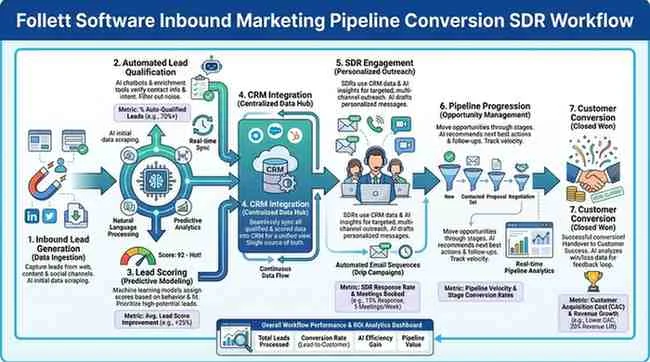
The inbound marketing pipeline conversion SDR workflow is the end-to-end process by which inbound leads — generated through content, SEO, paid media, or referrals — are captured, qualified, routed to SDRs, nurtured through CRM automation, and converted into sales opportunities.
It is not a single tool. It is the integration of four interconnected systems:
- Inbound demand generation — attracting the right audience at scale
- Lead qualification and scoring — separating high-intent prospects from noise
- SDR workflow — the human (or AI-assisted) process of engaging, qualifying, and advancing leads
- CRM automation — the infrastructure that routes, tracks, and accelerates every step
When these four systems are misaligned — when marketing sends unqualified leads, SDRs lack routing clarity, or CRM data is incomplete — pipeline conversion collapses. When they operate as a unified workflow, conversion rates improve, response times drop, and revenue becomes predictable.
Business value at a glance:
| Function | Without Workflow Alignment | With Aligned SDR Workflow |
|---|---|---|
| Lead response time | Hours to days | Under 5 minutes (automated) |
| MQL-to-SQL conversion | 10–20% average | 30–50% with AI qualification |
| SDR productivity | 40–60 touches/day | 100+ with CRM automation |
| Pipeline visibility | Fragmented, manual | Real-time, centralized |
| Revenue forecasting | Low confidence | Predictable with scoring data |
Why Is Inbound Pipeline Conversion Important for Revenue Growth?
Inbound pipeline conversion is the single most leveraged variable in B2B revenue growth — because increasing conversion rate by even a few percentage points delivers more revenue than equivalent increases in lead volume.
Consider a pipeline with 500 monthly inbound leads at a 2% close rate. Doubling lead volume to 1,000 without improving conversion yields 20 closed deals. Improving conversion from 2% to 4% on the original 500 leads produces the same result — at a fraction of the cost.
Why conversion rates remain low for most teams:
- Average lead response time in B2B is over 42 hours, while leads contacted within 5 minutes are 100x more likely to connect (InsideSales research)
- Only 27% of inbound leads are ever contacted by an SDR (MarketingSherpa)
- Most CRM workflows rely on manual tasks that create delays and inconsistency
- Misalignment between marketing’s definition of a “qualified lead” and sales’ reality produces friction at every handoff
Pipeline velocity — the speed at which leads move from inquiry to opportunity — depends on:
- How fast leads are engaged after submission
- How accurately they are qualified before SDR investment
- How efficiently the CRM routes, documents, and follows up on each contact
Improving these three variables transforms both revenue output and SDR productivity simultaneously.
How Do AI SDRs Improve Inbound Lead Qualification?
What Is an AI SDR?
An AI SDR (AI Sales Development Representative) is a software system that uses machine learning, natural language processing, and behavioral data to engage, qualify, and route inbound leads — performing the outreach and qualification tasks traditionally handled by human SDRs, but at greater speed and scale.
AI SDRs are not replacements for human judgment in complex sales cycles. They are productivity multipliers that handle the high-volume, repetitive qualification work so human SDRs can focus on high-intent, high-value conversations.
Common AI SDR capabilities include:
- Automated personalized email and chat responses within seconds of lead capture
- Behavioral signal analysis (email opens, page visits, content downloads)
- BANT or MEDDIC qualification via conversational AI
- Instant CRM record creation and lead scoring updates
- Calendar booking and meeting scheduling without human intervention
How Does Automated Lead Qualification Work?
Automated lead qualification uses predefined criteria — firmographics, behavioral signals, and engagement data — to score and categorize inbound leads the moment they enter the pipeline, without waiting for manual review.
A typical automated qualification sequence:
- Lead submits form → CRM creates record instantly
- Enrichment layer fires (e.g., Clearbit, ZoomInfo) → job title, company size, tech stack appended
- Scoring model applies → lead receives a numerical score based on ICP fit and engagement
- Threshold logic routes lead → high-score leads go to AI SDR or human SDR queue; low-score leads enter nurture
- AI SDR sends personalized outreach within minutes of submission
- Response triggers next action → qualified reply routes to human SDR for discovery call; non-response triggers follow-up sequence
This process reduces qualification time from days to minutes and ensures no inbound lead goes untouched.
Also Read: sonam-wangchuks-contributions-to-social-causes
How Does AI Lead Scoring Improve Conversions?
AI lead scoring improves conversions by predicting which leads are most likely to close, allowing SDRs to prioritize effort on the contacts with the highest revenue probability rather than working leads in arbitrary order.
Traditional lead scoring relies on manually assigned point values for static attributes (e.g., “+10 for job title, +5 for company size”). AI-powered scoring goes further by:
- Learning from historical won/lost deal data to identify patterns humans miss
- Incorporating real-time behavioral signals (time on pricing page, demo requests, repeat visits)
- Continuously recalibrating as new data arrives
- Flagging intent spikes — sudden increases in engagement that signal buying readiness
Organizations using predictive lead scoring report 20–30% improvements in MQL-to-SQL conversion rates and meaningful reductions in SDR time-per-qualified-lead.
Can AI SDRs Work Alongside Human SDRs?
Yes — the most effective SDR teams use a hybrid model where AI SDRs handle initial qualification and outreach while human SDRs focus on discovery, relationship-building, and opportunity advancement.
The hybrid model works as follows:
| Stage | AI SDR Role | Human SDR Role |
|---|---|---|
| Lead capture | Immediate personalized outreach | Notified of hot leads in real time |
| Initial qualification | Conversational qualification via email/chat | Reviews AI qualification summary |
| Meeting scheduling | Automates calendar booking | Prepares for discovery call |
| Discovery call | Provides intelligence brief | Conducts conversation, advances opportunity |
| Follow-up | Sends automated nurture sequences | Handles high-intent follow-up personally |
| CRM updates | Logs all interactions automatically | Reviews, annotates, advances stage |
This model allows a team of five human SDRs to handle the qualified output of what would previously require ten, without sacrificing the quality of human engagement where it matters most.
How Does CRM Automation Support SDR Workflow Efficiency?
CRM automation improves SDR workflow efficiency by eliminating manual data entry, enforcing consistent process execution, automating follow-up sequences, and giving SDRs real-time visibility into lead status and priority — so they spend time selling, not administering.
The gap between manual and automated CRM workflows is substantial:
| Manual Process | Automated CRM Workflow |
|---|---|
| SDR manually creates lead record after form submission | CRM auto-creates enriched record on submission |
| Lead assignment based on round-robin spreadsheet | Intelligent routing based on territory, score, and SDR capacity |
| Follow-up reminders set manually in calendar | Automated task creation and sequence enrollment |
| Meeting outcomes logged after the fact | Call notes auto-transcribed and logged via conversation intelligence |
| Pipeline stage updated by SDR memory | Stage progression triggered by defined behavioral criteria |
| Reporting built from manual exports | Real-time dashboards with pipeline velocity and conversion metrics |
| Lead nurture managed manually | Drip sequences triggered by lead score thresholds |
| Duplicate records created from multiple sources | CRM deduplication and merge rules applied automatically |
Key CRM automation workflows every SDR team should implement:
- Instant lead assignment — route new inbound leads to the right SDR within seconds of submission
- Enrichment on entry — append firmographic and technographic data automatically
- Sequence enrollment — enroll leads in the correct outreach sequence based on lead source and persona
- Meeting confirmation and reminders — automate pre-meeting prep and post-meeting follow-up
- Stage-change triggers — automatically update pipeline stage based on email replies, meetings booked, or form completions
- Stale lead alerts — notify SDRs when a lead has gone cold beyond a defined threshold
What Are the Key Components of a High-Converting Inbound Pipeline?
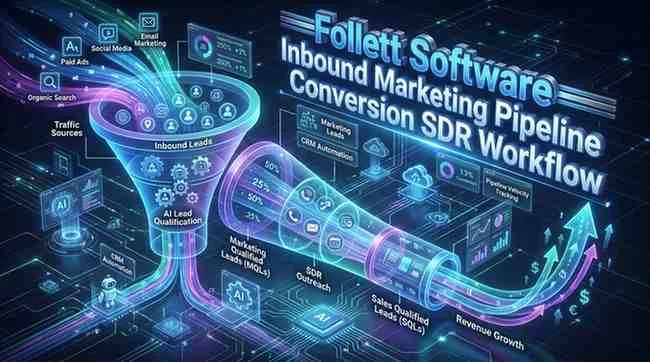
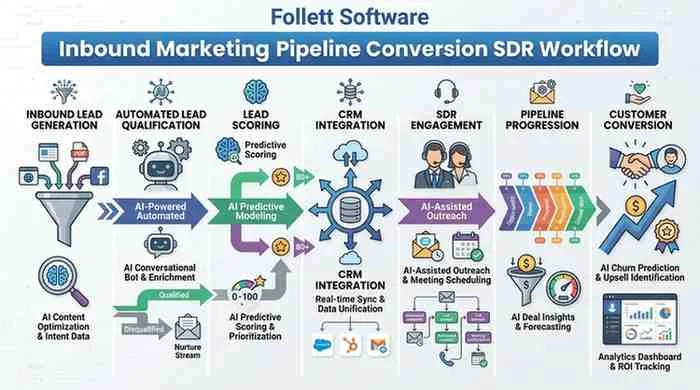
A high-converting inbound pipeline has six integrated components: lead capture, lead scoring, qualification, nurturing, opportunity creation, and conversion tracking — each dependent on the quality of the preceding stage.
1. Lead Capture Every inbound channel — organic search, paid media, content downloads, webinars, referrals — feeds leads into a centralized CRM. Form design, page experience, and offer relevance directly affect capture quality.
2. Lead Scoring Scoring combines ICP fit (firmographics, role, company size) with behavioral engagement (pages visited, emails opened, content consumed). Leads above a threshold route to SDRs; those below enter nurture.
3. Qualification SDRs (or AI SDRs) validate BANT or MEDDIC criteria: Budget, Authority, Need, Timeline (or Metrics, Economic Buyer, Decision Criteria, Decision Process, Identify Pain, Champion). This step separates marketing-qualified leads (MQLs) from sales-qualified leads (SQLs).
4. Lead Nurturing Leads not yet ready to buy receive automated sequences — email, retargeting, content offers — that maintain engagement and signal intent over time. Scoring continues during nurture; re-engagement triggers re-routing to SDRs.
5. Opportunity Creation Qualified leads become CRM opportunities with defined stage, value estimate, and close probability. SDRs hand off to Account Executives with a qualification summary.
6. Conversion Tracking Pipeline conversion rates are tracked at each stage: visitor-to-lead, lead-to-MQL, MQL-to-SQL, SQL-to-opportunity, opportunity-to-close. Stage-level data reveals exactly where the pipeline leaks.
How Can Businesses Scale Their Inbound Pipeline Without Increasing Headcount?
Businesses scale inbound pipelines without adding headcount by deploying AI SDRs for initial qualification, automating CRM workflows, improving lead scoring precision, and building self-service nurture tracks that maintain pipeline engagement continuously.
Also Read: crackstube
A practical scaling framework:
- Audit current pipeline capacity — identify the stage where volume currently breaks the process (most often at initial qualification)
- Deploy AI SDR for first-touch outreach — cover 100% of inbound leads immediately, regardless of volume spikes
- Implement lead scoring thresholds — prevent low-fit leads from reaching human SDRs at all
- Build automated nurture sequences — keep non-ready leads warm without SDR involvement
- Use CRM workflow automation — eliminate all manual tasks that don’t require human judgment
- Define clear MQL/SQL criteria jointly with marketing — reduce wasted SDR effort on misqualified leads
- Monitor pipeline velocity weekly — identify bottlenecks before they compound
Organizations that implement this framework typically see SDR capacity increase by 40–60% within 90 days without adding headcount.
What Are the Most Common Inbound Pipeline Bottlenecks?
| Bottleneck | Root Cause | Recommended Solution |
|---|---|---|
| Slow lead response time | Manual assignment and no automation | AI SDR immediate outreach + automated routing |
| High volume of unqualified leads | Broad ICP definition or weak lead scoring | Tighten scoring model; add enrichment on capture |
| Poor MQL-to-SQL conversion | Marketing and sales using different qualification criteria | Joint SLA defining MQL/SQL criteria |
| Leads falling through cracks | No CRM follow-up automation | Automated task creation and stale-lead alerts |
| SDR time wasted on bad-fit leads | No lead scoring or threshold routing | Predictive scoring + automated nurture for sub-threshold leads |
| CRM data quality issues | Inconsistent data entry; no enrichment | Mandatory fields + auto-enrichment on record creation |
| No pipeline visibility | Reporting built on manual exports | Real-time CRM dashboards with stage conversion metrics |
| Long sales cycle with no mid-funnel nurture | Leads handed to sales too early, then abandoned | Nurture tracks for leads in early discovery |
What Metrics Should Be Used to Measure SDR Workflow Performance?
The six metrics that most accurately predict SDR workflow health and inbound pipeline conversion are: lead response time, MQL-to-SQL conversion rate, pipeline velocity, SQL-to-opportunity rate, SDR activity-to-meeting ratio, and revenue attribution per SDR.
1. Lead Response Time Target: under 5 minutes for inbound leads. Every hour of delay reduces connection probability by roughly 10x.
2. MQL-to-SQL Conversion Rate Industry benchmark: 13% average; high-performing teams: 30–50%. Low rates indicate scoring problems or misaligned qualification criteria.
3. Pipeline Velocity Formula: (Number of Opportunities × Average Deal Value × Win Rate) ÷ Sales Cycle Length. A declining velocity number signals a bottleneck — this formula localizes where.
4. SQL-to-Opportunity Rate Measures how many sales-qualified leads actually become active pipeline opportunities. Declines here usually indicate qualification quality problems.
5. Activity-to-Meeting Ratio How many SDR touches (emails, calls, LinkedIn) are required to book one meeting. AI SDR deployment typically reduces this ratio significantly by improving first-touch relevance.
6. Revenue Attribution per SDR Tracks closed-won revenue influenced by each SDR’s pipeline contribution. Essential for evaluating the ROI of SDR headcount versus AI SDR investment.
How Can Marketing and Sales Teams Align for Better Pipeline Conversion?
Marketing and sales alignment on pipeline conversion requires a shared lead qualification definition (the SLA), joint visibility into pipeline data, regular feedback loops, and revenue operations as a neutral coordinating function.
The five pillars of effective alignment:
- Joint MQL/SQL definition — marketing and sales agree in writing on exactly what criteria define each lead stage. Reviewed quarterly.
- Shared pipeline dashboard — both teams see the same data: lead volume, conversion rates by source, stage progression, and revenue attribution. No siloed reporting.
- Feedback loop cadence — weekly or biweekly review where sales feeds back which MQLs converted and which didn’t, allowing marketing to refine targeting and scoring.
- Service Level Agreement (SLA) — marketing commits to MQL volume and quality targets; sales commits to response time and follow-up frequency standards. Accountability on both sides.
- Revenue operations as the connective tissue — RevOps owns the CRM, the reporting infrastructure, and the process documentation that keeps both teams working from the same playbook.
Organizations with strong marketing-sales alignment achieve 36% higher customer retention rates and 38% higher sales win rates (Aberdeen Group research).
Checkout: do-the-driving-modes-in-cadillac-lyriq-offer-different-ranges-or-battery-usages
What Are the Best Practices for Optimizing Inbound Marketing Pipeline Conversion?
Quick Wins (implement within 30 days):
- Set up automated lead response to engage every inbound lead within 5 minutes
- Define and document MQL/SQL criteria jointly with marketing and sales
- Implement lead enrichment on CRM record creation
- Build a stale-lead alert to flag contacts with no SDR activity after 48 hours
- Create a single pipeline dashboard visible to both marketing and sales
Process Improvements (30–90 days):
- Deploy AI lead scoring using historical won/lost data
- Build persona-specific nurture sequences for sub-threshold leads
- Implement conversation intelligence for call logging and coaching
- Create stage-based SLAs (e.g., MQL must be contacted within 4 hours; SQL must reach opportunity within 5 business days)
- Establish a weekly pipeline review cadence across marketing, sales, and RevOps
Strategic Improvements (90+ days):
- Deploy AI SDR for first-touch qualification on all inbound channels
- Build a predictive pipeline velocity model
- Implement multi-touch revenue attribution to understand which channels drive highest-converting leads
- Develop a formal SDR enablement program covering qualification methodology, CRM hygiene, and outreach frameworks
- Build a feedback loop between closed-won data and content strategy to generate more of the leads that actually convert
Real-World Example: How a B2B SaaS Company Scaled Inbound Conversion with AI SDRs and CRM Automation
The situation: A mid-market B2B SaaS company was generating 800 inbound leads per month from content, paid search, and event registrations. Their five-person SDR team had an average lead response time of 18 hours, an MQL-to-SQL conversion rate of 11%, and significant SDR frustration from working low-fit leads alongside high-intent prospects.
The problems identified:
- No lead scoring — SDRs worked leads in submission order
- No CRM enrichment on entry — SDRs manually researched every contact
- No automated first-touch outreach — every first email was written from scratch
- Marketing and sales used different definitions of a “qualified lead”
- No nurture track — leads not immediately contacted were abandoned
What they implemented:
- Deployed CRM enrichment (automated firmographic/technographic data append on record creation)
- Built an AI lead scoring model using 18 months of won/lost deal data
- Set a scoring threshold: leads above 70/100 route immediately to human SDR queue; leads below 70 enroll in a 6-week automated nurture sequence
- Deployed an AI SDR to handle first-touch outreach for all leads above threshold within 3 minutes of submission
- Created a joint MQL/SQL definition document reviewed and signed by VP Marketing and VP Sales
- Built a shared real-time pipeline dashboard in their CRM
Results after 90 days:
- Lead response time: 18 hours → under 4 minutes
- MQL-to-SQL conversion: 11% → 34%
- SDR meetings booked per week: 23 → 61
- SDR time spent on manual data entry: reduced by approximately 70%
- Pipeline value generated: increased by 140% with same headcount
Key lesson: The technology mattered less than the process alignment. The AI SDR and CRM automation only delivered results after the MQL/SQL definition was agreed and the scoring model was grounded in real historical data.
Frequently Asked Questions
What is an inbound pipeline?
An inbound pipeline is the structured sequence of stages through which inbound leads — people who have expressed interest in a product or service — move from initial inquiry to closed revenue. It typically includes lead capture, qualification, nurturing, opportunity creation, and close.
What is an SDR workflow?
An SDR workflow is the defined sequence of actions a Sales Development Representative takes to engage, qualify, and advance inbound or outbound leads. It includes outreach cadences, qualification criteria, CRM logging requirements, handoff procedures, and follow-up protocols.
How do AI SDRs qualify leads?
AI SDRs qualify leads by sending personalized outreach immediately after form submission, using conversational AI to assess BANT or MEDDIC criteria, analyzing behavioral signals, updating lead scores in real time, and routing qualified leads to human SDRs — all without manual intervention.
How does CRM automation improve conversions?
CRM automation improves conversions by ensuring every lead is contacted immediately, routed correctly, followed up consistently, and tracked accurately through every pipeline stage — eliminating the delays, missed follow-ups, and data gaps that cause leads to fall through.
What is lead scoring?
Lead scoring is a system that assigns numerical values to leads based on ICP fit (firmographics, role, company size) and behavioral engagement (pages visited, emails opened, content downloaded), enabling SDRs to prioritize the leads most likely to convert.
How can businesses scale inbound lead management?
By deploying AI SDRs for first-touch qualification, implementing automated nurture tracks for non-ready leads, tightening lead scoring thresholds, and using CRM workflow automation to eliminate manual SDR tasks — teams can handle significantly higher lead volumes without proportional headcount increases.
What metrics matter most for pipeline conversion?
Lead response time, MQL-to-SQL conversion rate, pipeline velocity, SQL-to-opportunity rate, and SDR activity-to-meeting ratio are the most predictive metrics for diagnosing pipeline health and conversion performance.
Can AI replace SDRs?
No — AI SDRs handle high-volume, repetitive qualification tasks effectively, but human SDRs remain essential for complex discovery, relationship-building, objection handling, and the judgment required in enterprise sales cycles. The most effective model is hybrid.
How do marketing and sales teams align effectively?
Through a jointly defined and documented MQL/SQL criteria, shared CRM visibility, a formal SLA with commitments from both sides, regular feedback loops, and revenue operations as a coordinating function.
What are the biggest causes of inbound pipeline bottlenecks?
Slow lead response times, absence of lead scoring, misaligned MQL/SQL definitions between marketing and sales, poor CRM data quality, lack of nurture tracks, and no automated follow-up are the most common and most damaging bottlenecks.
Final Thoughts on Follett Software Inbound Marketing Pipeline Conversion SDR Workflow
Scaling inbound pipeline conversion is not a single-tool problem or a single-team problem. The follett software inbound marketing pipeline conversion sdr workflow represents the integrated approach that high-performing revenue teams use: AI-assisted qualification, CRM automation, aligned marketing-sales processes, and rigorous measurement of the metrics that actually predict pipeline health.
The organizations that convert inbound interest into predictable revenue are not necessarily those with the most leads. They are the ones that respond fastest, qualify most accurately, nurture most intelligently, and align most tightly across the marketing-to-sales handoff.
Whether your immediate priority is reducing lead response time, improving MQL-to-SQL conversion, or scaling SDR capacity without adding headcount, the frameworks in this guide provide a practical starting point. The compounding effect of improving each stage — even incrementally — produces revenue outcomes that no individual tactic can match alone.
Found this guide useful? Share it with your demand generation, RevOps, or SDR leadership team. Leave a comment with the pipeline bottleneck your organization is working through right now — and subscribe for ongoing resources on CRM automation, AI SDR implementation, and inbound pipeline optimization.