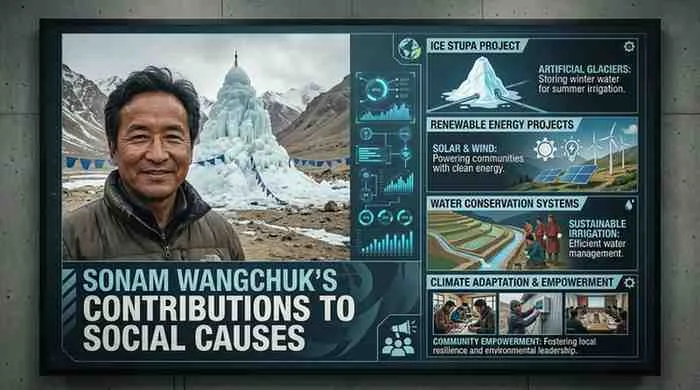
Few innovators in the modern world have blended practical engineering, grassroots education reform, and climate resilience as seamlessly as Sonam Wangchuk. Born in the remote trans-Himalayan region of Ladakh, India, Wangchuk has spent more than three decades demonstrating that locally-rooted, community-driven solutions can address problems that top-down systems routinely fail to solve.
Sonam Wangchuk’s contributions to social causes span multiple domains: reforming a broken school system through SECMOL, tackling water scarcity with the invention of the Ice Stupa artificial glacier, pioneering passive solar architecture, and founding HIAL to advance sustainable higher education.
This article examines each of those contributions in depth, exploring the real-world impact, the innovations behind them, and the lessons they hold for educators, environmentalists, and community leaders worldwide.
Who Is Sonam Wangchuk and Why Is He Influential in Social Development?
Sonam Wangchuk (born 1 September 1966) is an Indian engineer, educator, innovator, and environmentalist from Ladakh, widely recognized for his work in education reform, climate adaptation, and sustainable architecture.
Wangchuk was born in Alchi, a remote village in what was then Jammu & Kashmir (now the Union Territory of Ladakh). Until the age of nine, he was home-schooled by his mother in the Ladakhi language because no school existed in his village. When he was eventually enrolled in formal schooling in Srinagar — and later moved alone to Delhi as a twelve-year-old — he encountered a system that used Urdu and English as mediums of instruction, languages he did not yet understand. Teachers mistook his silence for a lack of intelligence.
This formative experience shaped his entire worldview. He went on to earn a B.Tech in Mechanical Engineering from NIT Srinagar and later pursued two years of graduate study in Earthen Architecture at CRAterre in Grenoble, France, in 2011. But long before those academic credentials, he had already returned to Ladakh and begun building institutions.
He is globally recognized not only for his technical innovations but for the moral clarity with which he links education, environment, and community dignity. He is sometimes described as the real-life inspiration behind the character “Phunsukh Wangdu” in the Hindi film 3 Idiots, though his actual body of work is far more substantive than any cinematic portrayal.
What Are Sonam Wangchuk’s Contributions to Social Causes?
Sonam Wangchuk’s contributions to social causes include founding SECMOL to reform education in Ladakh, leading Operation New Hope to overhaul government schools, inventing the Ice Stupa to address water scarcity, building a solar-powered campus, and establishing HIAL for sustainable higher education.
His work consistently operates at the intersection of three urgent problems: a failing education system that alienated Ladakhi youth, an accelerating climate crisis that threatens mountain livelihoods, and a lack of locally appropriate infrastructure. Rather than treating these as separate issues, Wangchuk addresses them together through institution-building and grassroots innovation.
| Area | Major Contribution | Impact |
|---|---|---|
| Education Reform | Founded SECMOL (1988); led Operation New Hope (1994) | Exam pass rates rose from ~5% to over 75% in participating schools |
| Sustainability | Designed solar-powered, earth-built SECMOL campus | Zero fossil fuel use for heating, cooking, and lighting |
| Climate Adaptation | Invented the Ice Stupa artificial glacier | Provides irrigation water in spring when glaciers are absent |
| Higher Education | Founded HIAL in Phyang Valley near Leh | Alternative university model for mountain communities |
| Community Empowerment | Village Education Committees; climate fasts; Ladakh autonomy advocacy | Local ownership of schools and environmental policy |
| Awards & Recognition | Ramon Magsaysay Award (2018), Rolex Award (2016), Global Award for Sustainable Architecture (2017) | International validation of community-led innovation |
How Did Sonam Wangchuk Transform Education in Ladakh?
Wangchuk transformed education in Ladakh by founding SECMOL in 1988 and then scaling those principles into a government-wide reform called Operation New Hope in 1994, which helped raise the 10th-grade pass rate from roughly 5% to over 75% in participating schools.
At the time SECMOL was founded, approximately 95% of Ladakhi children were “failing” by government school metrics — not because they lacked intelligence, but because the curriculum was delivered in unfamiliar languages, by undertrained teachers, using rote-memorization methods disconnected from local life and culture.
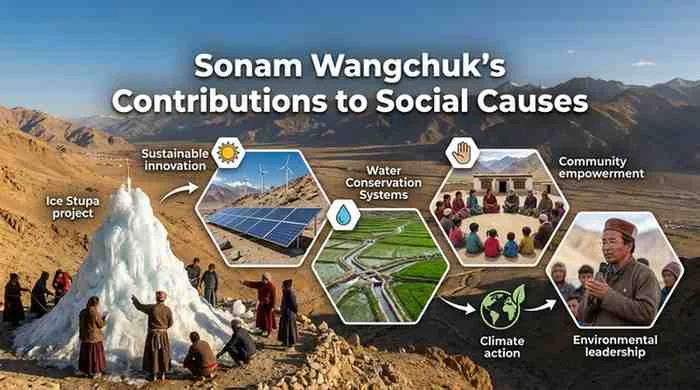
What Is SECMOL?
SECMOL — the Students’ Educational and Cultural Movement of Ladakh — was co-founded by Wangchuk in 1988, when he was just 22 years old, along with a group of Ladakhi students who had themselves been failed by the mainstream school system.
SECMOL’s core innovation was to replace an alienating, language-barrier-heavy system with one that:
- Used local languages and culturally relevant content
- Emphasized hands-on, experiential learning over rote memorization
- Gave students ownership of their own learning environment
- Built confidence among youth who had been told they were failures
The SECMOL campus itself became a statement of purpose. It was designed and built using local traditional materials and eco-technologies, including solar energy, making it one of the earliest examples of sustainable architecture in the region. The campus runs on no fossil fuels for cooking, lighting, or heating — even in Ladakhi winters where temperatures can fall below –30°C.
SECMOL graduates have gone on to become journalists, filmmakers, and social entrepreneurs — people who had previously failed conventional examinations multiple times.
How Does Experiential Learning Improve Education?
The experiential learning model at SECMOL treats education as a product of relationship — between students and their environment, between theory and practice, between school and community. Students are not merely passive recipients of instruction; they participate in running the campus, designing projects, and solving real local problems.
This approach:
- Builds self-confidence in students who have been labelled failures by conventional metrics
- Connects learning to livelihood by addressing real-world challenges in Ladakh
- Develops practical skills such as construction, agriculture, solar energy management, and media production
- Preserves cultural identity by incorporating Ladakhi language, history, and values
HIAL, the institution Wangchuk later founded for higher education, carries forward this philosophy with its guiding principle: “Bright Head, Kind Heart, and Skilled Hands” — a deliberate departure from the conventional three Rs.
What Was Operation New Hope?
Operation New Hope was launched in 1994 as a triangular collaboration between the government, village communities, and civil society — with SECMOL as a key civil society partner. It was designed to overhaul the public school system across Ladakh, not just serve students who had already dropped out.
Key elements of Operation New Hope included:
- Formation of Village Education Committees to give communities ownership of local schools
- Teacher training in child-friendly, culturally sensitive pedagogical methods
- Rewriting and publishing localised textbooks for Ladakh
- Curriculum reform to make content environmentally and culturally relevant
The results were remarkable. Exam pass rates at the 10th-grade level rose from approximately 5% to over 75% in participating schools. The initiative was eventually adopted as Ladakh’s official education policy, and the local administration made primary education its top priority. Operation New Hope earned Wangchuk advisory roles in Ladakh’s Hill Council and in national education policy discussions.
Also Read: ohio-champion-trees-delaware-county-usd-lewis-center
How Does Sonam Wangchuk Promote Sustainable Social Development?
Wangchuk promotes sustainable social development by designing infrastructure that uses local materials and renewable energy, training communities to build and maintain these systems, and demonstrating that ecological responsibility and human development are inseparable goals.
His approach rejects the dichotomy between economic development and environmental preservation. The SECMOL campus, built from earth and mud using traditional Ladakhi construction techniques, maintains an interior temperature of approximately +18°C even when outside temperatures fall to –18°C — without any external heating fuel. This is achieved through passive solar design: south-facing mud walls and double-glazed windows that trap and retain solar heat.
Key sustainable development principles embedded in his work:
- Use of local materials reduces cost and carbon footprint
- Community participation ensures maintenance and ownership
- Renewable energy integration makes infrastructure self-sufficient
- Livelihood linkage ensures sustainability serves real human needs, not just environmental metrics
His later work through HIAL expanded this into eco-tourism, high-altitude plantation, passive solar housing at scale, and water conservation — creating a model where sustainable infrastructure becomes an engine of local economic development.
What Is the Ice Stupa Project and Why Is It Important?
The Ice Stupa is an artificial glacier invented by Sonam Wangchuk that stores unused stream water during winter in the form of a large conical ice structure, then releases it as meltwater in late spring — precisely when Ladakhi farmers need irrigation water but natural glaciers have not yet begun to melt.
The problem it solves is a timing mismatch, not a total water shortage. In Ladakh, snowmelt from high glaciers arrives in summer, but crops planted in spring desperately need water before that summer melt begins. In the past, smaller local glaciers at lower altitudes provided this early-season water. As those glaciers have receded due to climate change, spring water scarcity has increased, directly threatening agricultural livelihoods.
Wangchuk’s solution was elegantly simple: pipe stream water from higher elevations through underground channels to a flat site at lower elevation. The water pressure causes it to fountain upward in winter, freeze on contact with the cold air, and accumulate into a cone-shaped ice tower — resembling the Buddhist stupas that are common in Ladakh, hence the name.
| Challenge | Ice Stupa Solution | Social Benefit |
|---|---|---|
| Spring water scarcity | Stores winter stream water as ice | Reliable irrigation for farmers in April–May |
| Glacial recession from climate change | Replaces shrinking lower-altitude glaciers | Protects agricultural livelihoods |
| High construction costs | Uses gravity-fed pipes and natural freezing | Low-cost, replicable technology |
| Community acceptance | Culturally resonant stupa design | Integration into local cultural and religious life |
| Scalability | Modular design with no moving parts | Can be replicated across Himalayan villages |
The Ice Stupa design won the Rolex Award for Enterprise in 2016, with a prize of $150,000 that Wangchuk used as seed funding for HIAL. The project demonstrated that climate adaptation can be both technically sound and culturally resonant — a principle with implications far beyond Ladakh.
How Has Sonam Wangchuk Contributed to Climate Action?
Sonam Wangchuk has contributed to climate action through the Ice Stupa project, passive solar architecture, renewable energy integration, public climate advocacy including hunger strikes, and founding institutions that train future generations in climate-resilient development.
Climate Resilience
The Ice Stupa directly addresses climate resilience by replacing the functions of disappearing glaciers with a locally managed, low-tech solution. It treats climate adaptation not as a government programme but as something communities can design and own. This community-centred model of resilience is transferable to other mountain ecosystems facing similar glacial retreat.
Environmental Sustainability
The SECMOL campus runs entirely on solar energy — no fossil fuels for heating, cooking, or lighting. Wangchuk has designed and taught students to build solar water heaters, passive solar rooms, and earth-construction techniques that dramatically reduce the carbon and resource footprint of buildings in high-altitude environments. These are not demonstration projects; they are lived infrastructure used daily.
Renewable Energy Initiatives
At both SECMOL and HIAL, Wangchuk has integrated renewable energy as a practical learning subject, not just an environmental commitment. Students design and build solar systems as part of their education. This approach seeds future adoption across Ladakh’s villages by training a generation of practitioners rather than only advocates.
Sustainable Infrastructure
Through HIAL, Wangchuk is building a campus in the Phyang Valley near Leh that applies all these principles at a higher education scale — solar-heated buildings, earth construction, water conservation systems, and eco-tourism infrastructure, all designed with and for mountain communities.
Wangchuk has also engaged in direct climate advocacy. He undertook a 21-day climate hunger fast to draw attention to Ladakh’s environmental vulnerability and the need for constitutional protections for the region’s ecology and communities.
What Role Does HIAL Play in Sustainable Development?
HIAL — the Himalayan Institute of Alternatives, Ladakh — is a higher education institution founded by Wangchuk that trains students in sustainable livelihoods, water conservation, passive solar housing, eco-tourism, and other solutions specifically designed for mountain communities.
HIAL grew directly from the success of SECMOL and the Ice Stupa project. After winning the Rolex Award in 2016, Wangchuk used the prize money as seed funding and secured land in the Phyang Valley near Leh, donated by the Phyang monastery after the Buddhist leader Chetsang Rinpoche blessed the Ice Stupa pilot.
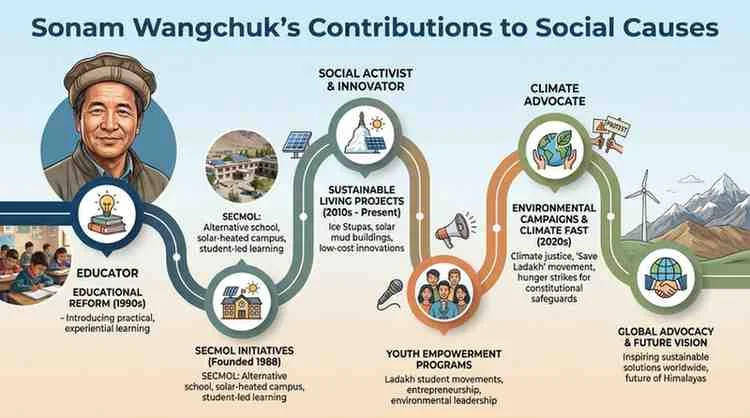
HIAL’s guiding philosophy — “Bright Head, Kind Heart, and Skilled Hands” — explicitly moves beyond the conventional academic model to integrate ethical development, practical skills, and intellectual rigour. Its curriculum focuses on:
- Water conservation and management for mountain ecosystems
- Passive solar and earth construction techniques
- Eco-tourism as a sustainable livelihood pathway
- High-altitude plantations and ecological restoration
- Cultural preservation as a component of sustainable development
HIAL is intentionally positioned as an alternative to models that push Ladakhi youth toward urban migration. By offering high-quality higher education that leads to livelihoods in Ladakh, it addresses a fundamental social problem: the drain of educated young people away from mountain communities.
How Has Sonam Wangchuk Empowered Local Communities?
Wangchuk has empowered local communities by building institutions that give ordinary Ladakhis — farmers, students, teachers, and villagers — direct ownership of education, water, energy, and environmental solutions.
His approach consistently rejects dependency. Operation New Hope created Village Education Committees that put governance of local schools in community hands. The Ice Stupa project was designed to be replicable by any village with access to a stream and winter temperatures below freezing — no specialized technology required. The SECMOL campus trains students to build and maintain its own solar systems.
Key community empowerment strategies in his work:
- Participatory governance — communities co-design and co-manage the interventions
- Skills transfer — building local capacity rather than dependence on external experts
- Cultural affirmation — using Ladakhi language, values, and aesthetics rather than imposing external models
- Economic relevance — linking education and innovation directly to local livelihoods
- Political advocacy — Wangchuk has also advocated for Ladakh’s constitutional rights and greater political autonomy, recognising that institutional empowerment requires political protection
He has spoken extensively about the need to preserve Ladakh’s ecological and cultural identity, particularly following the region’s reorganisation as a Union Territory in 2019 and the abrogation of Article 370. His advocacy reflects a conviction that community empowerment is incomplete without structural protections.
Also Read: self-cleaning-street-lamp-research-dust-resistant-lamp-project-exist
What Awards and Recognition Has Sonam Wangchuk Received?
| Award | Year | Significance |
|---|---|---|
| Ashoka Fellowship for Social Entrepreneurship | 2002 | Recognized as a leading social innovator in India |
| Real Heroes Award | 2008 | Acknowledged for grassroots impact in education |
| Rolex Award for Enterprise | 2016 | Awarded for the Ice Stupa project; $150,000 prize used to seed HIAL |
| Fred M. Packard Award | 2016 | International recognition for conservation contribution |
| Global Award for Sustainable Architecture | 2017 | Recognized for passive solar, earth-construction design work |
| Ramon Magsaysay Award | 2018 | Asia’s most prestigious public service award; cited for collaborative learning reform and science-culture integration |
The Ramon Magsaysay Award — often called “Asia’s Nobel Prize” — is the most significant of these recognitions. The award committee specifically cited Wangchuk’s “collaborative and community-driven reform of learning systems” and his work “harnessing science and culture for community progress in remote northern India.”
What Lessons Can Society Learn from Sonam Wangchuk’s Work?
Wangchuk’s work demonstrates that lasting social change requires cultural relevance, community ownership, and solutions designed from the inside out rather than imposed from above.
1. Innovation does not require high technology. The Ice Stupa uses gravity, cold air, and a pipe. Its genius is in understanding a local problem precisely enough to solve it simply. This challenges the assumption that effective climate solutions must be expensive or complex.
2. Education reform needs cultural grounding. SECMOL succeeded where government schools failed because it started from Ladakhi students’ actual experience, language, and identity. Any education reform that ignores cultural context will struggle with the same problems.
3. Sustainability is most durable when tied to livelihoods. HIAL’s model of linking green architecture, water conservation, and eco-tourism to actual employment pathways ensures that sustainability is not a values statement but a practical choice with real economic benefits.
4. Community ownership is the most powerful scaling mechanism. Operation New Hope scaled because it created Village Education Committees — not because it produced a government programme. When communities own a solution, they maintain it.
5. Advocacy and institution-building reinforce each other. Wangchuk has not limited himself to building schools and glaciers. He has also engaged in public fasts, political advocacy, and media outreach to protect the conditions that make his work possible.
What Are the Most Important Facts About Sonam Wangchuk?
| Topic | Key Insight |
|---|---|
| Education | Founded SECMOL in 1988; helped raise Ladakh’s 10th-grade pass rate from ~5% to over 75% via Operation New Hope |
| Sustainability | Designed SECMOL campus to run on zero fossil fuels using passive solar and earth construction |
| Climate Action | Invented the Ice Stupa artificial glacier in 2014 to solve spring water scarcity caused by glacial retreat |
| Innovation | Won Rolex Award for Enterprise (2016) and Global Award for Sustainable Architecture (2017) |
| Community Impact | Created Village Education Committees; founded HIAL for community-focused higher education |
| Awards | Ramon Magsaysay Award (2018); Ashoka Fellowship (2002); Rolex Award (2016); Global Sustainable Architecture Award (2017) |
Frequently Asked Questions About Sonam Wangchuk’s Contributions to Social Causes
What are Sonam Wangchuk’s contributions to social causes?
Wangchuk’s contributions include founding SECMOL to reform Ladakh’s education system, leading Operation New Hope to overhaul government schools, inventing the Ice Stupa artificial glacier for water conservation, designing solar-powered sustainable buildings, and founding HIAL for alternative higher education. His work spans education, climate adaptation, sustainable architecture, and community empowerment.
How did Sonam Wangchuk improve education in Ladakh?
He co-founded SECMOL in 1988 to provide alternative education for students failed by the mainstream system. In 1994 he led Operation New Hope, a government-civil society collaboration that reformed curricula, trained teachers, and created community-managed schools. Pass rates in participating schools rose from approximately 5% to over 75%.
What is SECMOL?
SECMOL (Students’ Educational and Cultural Movement of Ladakh) is a non-profit organization founded in 1988 in Ladakh, India. It provides an alternative, experiential education model that uses local language and culture, hands-on learning, and student empowerment. Its solar-powered campus in Phey, Ladakh, uses no fossil fuels for heating, cooking, or lighting.
What is HIAL?
HIAL (Himalayan Institute of Alternatives, Ladakh) is a higher education institution founded by Wangchuk in the Phyang Valley near Leh. Seeded with the $150,000 Rolex Award prize, it offers training in sustainable livelihoods, water conservation, passive solar housing, eco-tourism, and mountain-region development. Its philosophy is “Bright Head, Kind Heart, and Skilled Hands.”
How does the Ice Stupa project work?
The Ice Stupa uses underground pipes to bring stream water from higher altitudes to a lower-elevation site. In winter, the water fountains upward, freezes in sub-zero air, and accumulates into a large conical ice tower (resembling a Buddhist stupa). This stored water melts in late spring, providing irrigation water to farmers at precisely the time when glacial meltwater is not yet available.
Why is Sonam Wangchuk important for climate action?
Wangchuk is important for climate action because he has developed practical, community-led climate adaptation solutions — particularly the Ice Stupa — that address real consequences of glacial retreat without requiring expensive technology. He also advocates publicly for environmental protection and has used fasts and protests to draw attention to Ladakh’s ecological vulnerability.
What awards has Sonam Wangchuk won?
His major awards include the Ashoka Fellowship (2002), Real Heroes Award (2008), Rolex Award for Enterprise (2016), Fred M. Packard Award (2016), Global Award for Sustainable Architecture (2017), and the Ramon Magsaysay Award (2018).
How has Sonam Wangchuk empowered local communities?
By creating institutions that give communities direct ownership of education (Village Education Committees), water (Ice Stupa), and livelihoods (HIAL), and by ensuring all his solutions are low-cost, locally replicable, and culturally resonant, Wangchuk has consistently built local capacity rather than dependence.
What lessons can leaders learn from Sonam Wangchuk?
Leaders can learn that effective innovation starts with deep understanding of local context; that education must be culturally grounded to be effective; that climate solutions are most durable when linked to community livelihoods; and that sustained institution-building is more powerful than one-time interventions.
Why is Sonam Wangchuk globally recognized?
Wangchuk is globally recognized because his work addresses universal problems — failing schools, water scarcity, climate adaptation — with replicable, low-cost solutions that have measurable results. The Ramon Magsaysay Award specifically cited his ability to harness both science and culture for community progress. His story also resonates internationally because it challenges the assumption that innovation must come from wealthy, technologically advanced societies.
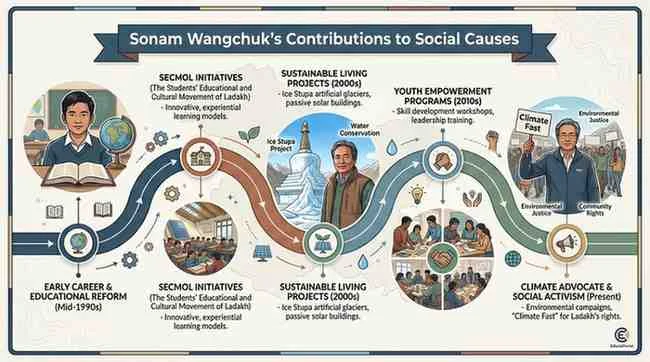
What Can Educators, Environmentalists, and Community Leaders Learn from Sonam Wangchuk?
The lessons from Wangchuk’s decades of work are applicable well beyond Ladakh. Here are the most transferable insights:
For Educators:
- Start from students’ lived experience, not from standardized curricula
- Teach with the environment as classroom, not just as subject matter
- Build student agency — give learners ownership of their learning space
- Connect education to local identity and cultural pride
- Measure success by human flourishing, not only pass rates
For Environmentalists:
- Frame climate solutions around community benefit, not just ecological goals
- Design for local replication, not one-off demonstration
- Ensure solutions are affordable enough for the communities most affected
- Partner with cultural and religious institutions to gain trust and legitimacy
- Combine technical innovation with public advocacy for systemic change
For Community Leaders:
- Participatory governance is a sustainability strategy, not just a democratic nicety
- Skills transfer is more valuable than delivering solutions
- Protect community agency from political and institutional dependence
- Build institutions, not just projects — durable change requires structures
- Advocate at the policy level to protect the conditions that make grassroots work possible
What Is the Lasting Impact of Sonam Wangchuk’s Contributions to Social Causes?
Sonam Wangchuk’s contributions to social causes have produced changes that outlast any individual project or award. The schools reformed through Operation New Hope continue to serve Ladakhi children under a community-managed model. The Ice Stupa has been replicated in multiple Himalayan villages. HIAL is training a generation of young people in sustainable livelihoods. And the SECMOL campus remains a working proof-of-concept that zero-fossil-fuel architecture is practical, not aspirational, even in one of the world’s harshest climates.
More broadly, his work has demonstrated something important to the global conversation about sustainable development: that the most effective solutions to complex problems — educational failure, climate adaptation, rural livelihoods — are often not the most technologically sophisticated ones. They are the ones designed with the deepest understanding of local conditions, delivered through community partnership, and sustained by institutions that give people genuine ownership.
His legacy is not merely a list of projects and awards. It is a model of how to think about social change: start with the people most affected, build with local materials and knowledge, link education to environment and community, and measure success by whether people’s lives have genuinely improved.
If you found this article valuable, share it with educators, sustainability advocates, and social innovators in your network. Leave a comment sharing which aspect of Wangchuk’s work resonates most with your own context — whether you work in education, environmental advocacy, or community development. And explore related content on climate resilience, experiential learning, and grassroots social innovation to continue building your understanding of what effective social change looks like in the 21st century.